




The Spaza Shop Support Fund is not running out of money. That’s the part most shop owners get wrong.
The government set aside R500 million. By the middle of 2026, about R179.6 million had been approved. Somewhere near R320 million is still sitting there, and the reason it isn’t moving has almost nothing to do with competition and almost everything to do with paperwork.
If your documents are in order, you’re applying into a much smaller pool than you think.
Where the money has gone
The fund has received 4,522 complete applications nationally. Of those, 4,240 have been assessed and 2,369 approved. SEDFA has backed 1,316 businesses worth R79.6 million, and the National Empowerment Fund 1,053 businesses worth R99.9 million.
Set that against the size of the sector. Roughly 82,000 spaza shops registered with municipalities during the 2025 registration drive. Verification confirmed 44,696 of them. Only around 15,000 hold an approved trading permit or licence.
So out of about 15,000 shops that could realistically apply, only 4,522 have. Just over half of those who applied were approved.
The Minister of Small Business Development has described the pace as slow, pointing to the number of parties involved in coordinating inspections, citizenship verification, and site and health checks. But the sharper number is this one: only 58% of applicants could be linked to a valid business licence or temporary municipal permit.
That’s the bottleneck. Not the budget.
What you can get
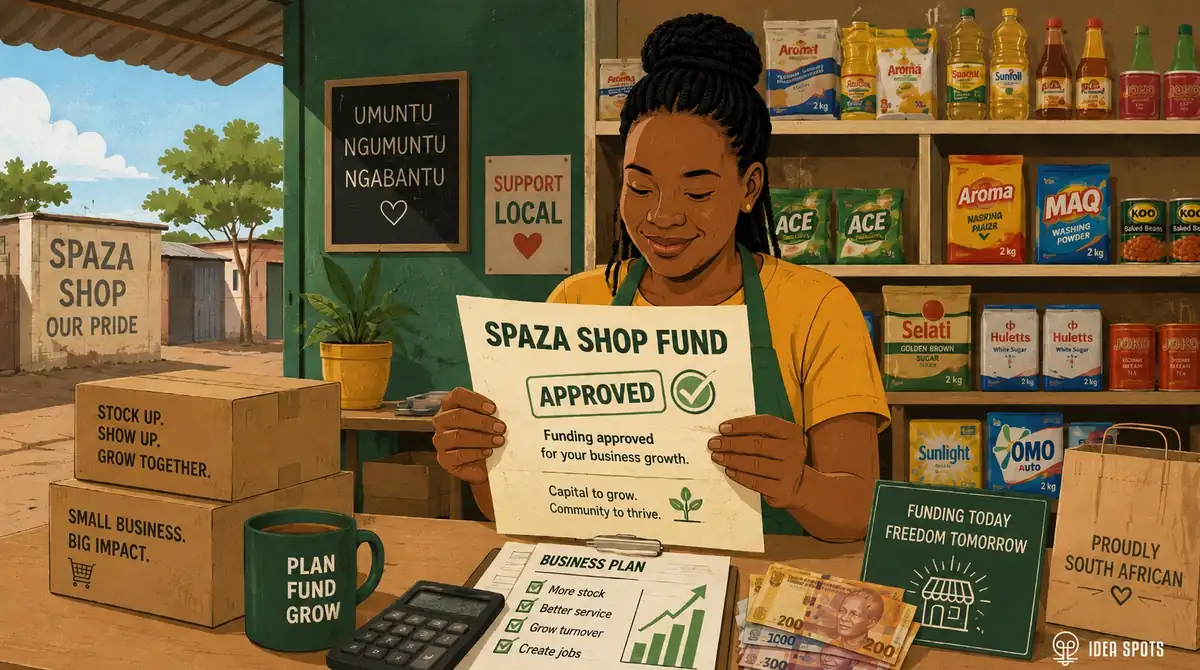
The fund offers qualifying businesses up to R100,000.
Funding above R50,000 comes as a blend, half grant and half loan. Below that threshold, the terms are more favourable. If you’re applying for more than R80,000, you’ll need to register with CIPC within six months of receiving the money.
The support can be used for shop upgrades, business training and stock purchases. In practice that covers refrigeration, shelving, security, point of sale devices and your opening or replenishment stock. Our breakdown of spaza shop container prices prices those items line by line, which is useful when you’re working out how much to ask for.
There’s also non-financial support attached, including training in business skills, digital literacy, credit health, food safety and compliance.
Who qualifies
To be eligible:
- You must be a South African citizen, or have been naturalised as a South African citizen before 1994
- The shop must operate in a township or rural area and serve the local community
- The business must be registered with your local municipality in line with the relevant by-laws and licensing requirements
- You must be registered with SARS, or qualify for a six-month transitional period
- The shop must comply with food preparation, health and safety legislation
- You must actively manage the business yourself
That last point matters more than it looks. The fund is designed for owner-operated shops, and there are verification measures specifically aimed at preventing fronting.
The documents you’ll need
- A certified copy of your South African identity document
- Business registration documents
- Proof of your business address
- Proof that the shop is operational
- Bank account confirmation documents
- A business permit issued by the municipality
Point six is where most applications die. The permit has to come from the municipality itself, not from a councillor, and it has to be valid. If you don’t have one yet, our guide to the spaza shop permit application form walks through how to get it and the order to do it in.
Get the permit first. Everything else on this list is straightforward by comparison, and applying without it wastes months.
How to apply
Step 1. Check that you qualify. Go through the eligibility list above against your own situation before you start. If you fall short on the permit, fix that first.
Step 2. Gather your documents. Have all six ready and scanned before you open the portal. Certified copies must be recent.
Step 3. Apply online. Applications go through the SEDFA portal at systemsnew.sefa.org.za/SMMEPortal. Create an account, complete the registration page, accept the terms, and submit. Check that every document uploads properly, since incomplete applications sit in the queue rather than moving forward.
Step 4. Wait for assessment. Applications are assessed against the programme requirements, and you may be contacted for extra information. Answer quickly. Applications that go quiet tend to stay quiet.
You can also apply through the National Empowerment Fund, or visit your nearest SEDFA office to submit documents in person. Details are on the official fund site.
Who gets priority
The fund gives priority consideration to three groups:
- Young entrepreneurs between 18 and 35
- Women-owned businesses
- Businesses owned by people with disabilities
If you fall into one of these, say so clearly in your application.
Getting help in person
SEDFA runs outreach sessions around the country where officials help with eligibility questions, new applications, business registration and compliance. Sessions have run in Limpopo through July 2026, including Polokwane and Marble Hall, and the nationwide campaign restarted in June 2026.
These are worth attending if your paperwork is complicated. Bring every document you have. Getting a compliance problem diagnosed face to face is faster than discovering it three months into an online application.
Check the fund website for upcoming dates in your district.
Contacts
- Spaza Shop Support Fund call centre: 011 305 8080
- Email: Spazafund@nefcorp.co.za
- NEF call centre: 0861 843 633
- SEDFA call centre: 012 748 9600
- SEDFA email: helpline@sefa.org.za
Lines are open Monday to Friday from 9am to 10pm, and Saturday from 9am to 3pm.
Common questions
Is there a closing date? Applications are open on a rolling basis rather than to a fixed deadline. The registration deadline that closed in February 2025 was for municipal registration, which is a separate process from applying to the fund.
Can I apply if my shop isn’t registered with CIPC? Yes, for smaller amounts. CIPC registration becomes a requirement if you receive more than R80,000, and you then have six months to complete it.
What if I don’t have a municipal permit yet? Get one before applying. It isn’t optional, and it’s the single most common reason applications fail. Start with your municipality’s Environmental Health department for the Certificate of Acceptability, then the business licensing office.
How long does approval take? There’s no published turnaround. Given the inspections and verification involved, plan for several months rather than weeks, and keep trading in the meantime.
Does the loan portion need security? The loan half is offered at low interest through SEDFA and the NEF as development finance rather than commercial lending. Terms are confirmed at approval, so ask what the repayment schedule looks like before you accept.
Can foreign nationals apply? No. The fund is restricted to South African citizens, or people naturalised before 1994. A municipal trading licence is a separate matter, and foreign nationals with the correct Home Affairs documentation can hold one, but they can’t access this fund.
What if my application is rejected? Ask for the reason. Most rejections trace back to a missing or invalid permit, incomplete documents, or a shop that couldn’t be verified as operational. All three can be fixed and resubmitted.