



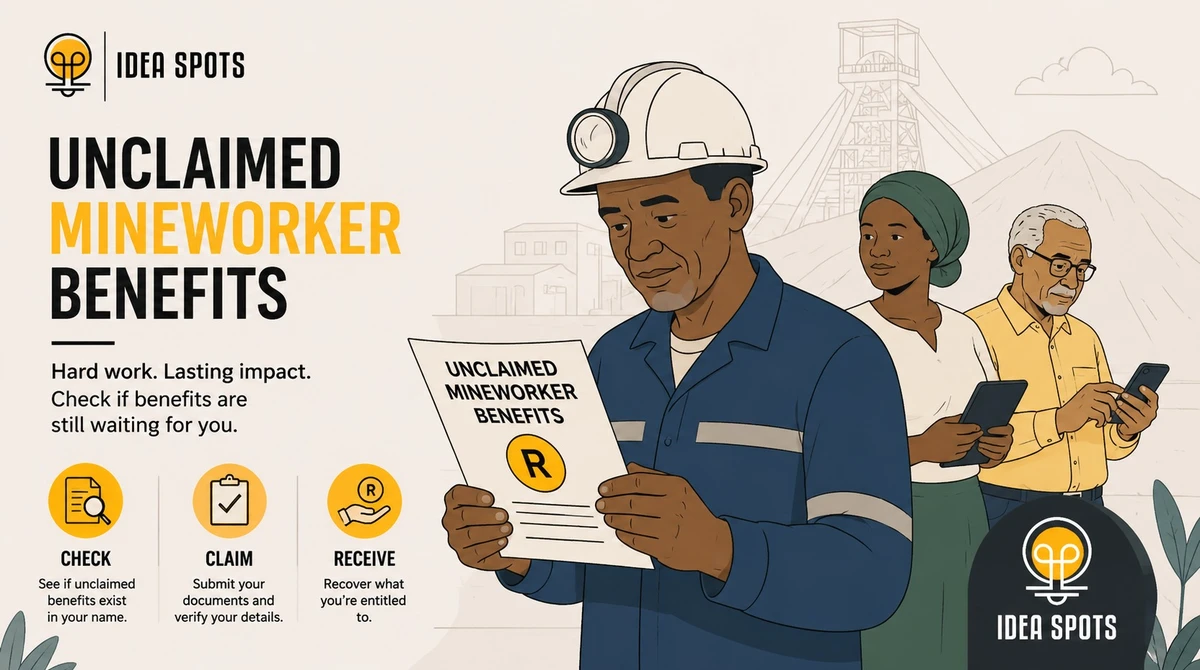

South Africa’s mining industry has employed millions of people over the past century. While many former mineworkers successfully claimed their retirement benefits after leaving employment, thousands of others never received money that was due to them. In many cases, workers changed addresses, returned to rural communities or neighbouring countries, or passed away before completing the claims process.
As a result, significant amounts of money remain unclaimed in retirement funds, while some former mineworkers and their families may also qualify for occupational disease compensation.
If you believe you or a deceased family member worked in South Africa’s mining industry, it is worth checking whether any benefits remain unpaid.
If you are unsure whether the missing money is a retirement benefit, compensation payment, policy, dividend or another type of asset, use our complete unclaimed-money checklist for South Africa to choose the correct search route.
Related: Read our guide on how to check unclaimed pension fund benefits in South Africa.
What Are Unclaimed Mineworker Benefits?
Unclaimed mineworker benefits refer to retirement or death benefits that have not been paid to their rightful owners or beneficiaries.
These benefits usually become unclaimed because:
- The mineworker could not be contacted after leaving employment.
- Contact information became outdated.
- The employee moved to another province or country.
- The mineworker passed away before submitting a claim.
- Family members were unaware that benefits existed.
- Required documentation was never completed.
Many of these benefits remain available until the rightful claimant is identified.
Retirement Benefits vs Occupational Disease Compensation
One of the biggest misconceptions is that all mineworker payments come from the same programme.
In reality, there are two completely different categories.
Retirement Benefits
These are employment-related benefits earned while working for a mining company and may include:
- Pension fund benefits
- Provident fund benefits
- Death benefits payable to beneficiaries
These benefits are administered by the relevant retirement fund or its administrator.
Occupational Disease Compensation
Former mineworkers diagnosed with occupational lung diseases such as silicosis or work-related tuberculosis may qualify for compensation under South Africa’s occupational health compensation programmes.
These compensation schemes are separate from retirement funds and have their own eligibility requirements.
Understanding this distinction can save applicants considerable time when deciding where to submit their claim.
Who Can Claim?
You may qualify if you are:
- A former mineworker.
- A retired mineworker.
- A mineworker who left employment years ago.
- The spouse of a deceased mineworker.
- A child or legal dependant.
- The executor of a deceased estate.
Eligibility depends on the rules of the relevant retirement fund or compensation programme.
How to Check for Unclaimed Mineworker Benefits
Step 1: Gather Employment Information
Before making enquiries, collect as much information as possible, including:
- Full name
- South African ID or passport
- Employee number (if known)
- Mining company name
- Years of employment
- Old payslips
- Employment records
- Pension or provident fund statements (if available)
Even partial information can help trace historical records.
Step 2: Contact the Relevant Retirement Fund
If you know the mining company where the employee worked, contact its pension or provident fund administrator.
The administrator can determine whether retirement benefits remain unpaid.
Step 3: Use the FSCA Unclaimed Benefits Search
The Financial Sector Conduct Authority (FSCA) provides an Unclaimed Benefits Search service that helps individuals determine whether they have unclaimed retirement fund benefits.
If a match is found, the relevant fund administrator can advise on the next steps and documentation required.
Step 4: Contact TEBA
TEBA has worked with the mining industry and government for many years to assist former mineworkers and their families.
Depending on your circumstances, TEBA may help with:
- Tracing employment records
- Verifying mining employment
- Assisting with benefit enquiries
- Guiding former mineworkers through available claim processes
If you are unsure where to begin, TEBA is often an appropriate starting point.
Step 5: Check Occupational Disease Compensation
Former mineworkers who developed occupational lung diseases may also qualify for compensation.
If you believe your illness resulted from working in the mines, enquire through the appropriate government compensation programme to determine your eligibility.
Documents You May Need
Although requirements vary, applicants are commonly asked to provide:
- South African ID or passport
- Proof of employment
- Banking details
- Proof of residence
- Marriage certificate (where applicable)
- Birth certificates for children
- Death certificate (for deceased mineworkers)
- Letters of executorship (where applicable)
Providing certified copies can help reduce delays.
Claiming Benefits for a Deceased Mineworker
If the mineworker has passed away, eligible dependants may still be able to claim outstanding benefits.
Depending on the circumstances, administrators may request:
- Death certificate
- Identity documents
- Marriage certificate
- Birth certificates
- Proof of relationship
- Letters of executorship where required
Each retirement fund considers beneficiaries according to its rules and applicable South African legislation.
Organisations That Can Help
| Organisation | How They Can Help |
|---|---|
| Financial Sector Conduct Authority (FSCA) | Provides the Unclaimed Benefits Search service for retirement funds. |
| TEBA | Assists former mineworkers with tracing employment records and benefit enquiries. |
| Retirement Fund Administrator | Confirms whether pension or provident fund benefits remain available. |
| Department of Health Compensation Programme | Assists eligible former mineworkers seeking occupational disease compensation. |
Beware of Scams
Former mineworkers and their families are sometimes targeted by fraudsters who promise to “unlock” compensation or retirement benefits in exchange for upfront fees.
Never pay anyone who guarantees they can secure your benefits.
Always use official organisations and verify any requests before providing personal information or making payments.
How Long Does the Claims Process Take?
Processing times depend on several factors, including:
- Employment verification
- Availability of historical records
- Completeness of submitted documents
- Number of beneficiaries
- Complexity of the claim
Straightforward cases may be resolved relatively quickly, while older or more complex claims can take considerably longer.
Tips for a Successful Claim
To improve your chances of success:
- Keep certified copies of all documents.
- Submit accurate banking details.
- Respond promptly to requests for additional information.
- Retain copies of every document submitted.
- Update your contact details if they change.
Frequently Asked Questions
Can I claim benefits on behalf of my deceased father or mother?
Yes. Eligible dependants or the executor of the estate may be able to claim outstanding retirement benefits.
Can I still claim if I worked in the mines many years ago?
Yes. Many successful claims relate to employment that ended decades ago.
What if I don’t know which mine employed my relative?
Start by gathering any available employment records and contact TEBA for guidance on tracing employment history.
Are retirement benefits and occupational disease compensation the same?
No. Retirement benefits are separate from occupational disease compensation and are administered through different processes.
Can former mineworkers from neighbouring countries claim?
Yes. Former mineworkers from countries such as Lesotho, Mozambique, Zimbabwe, Botswana, Eswatini, and Malawi may also qualify if they worked in South Africa.