

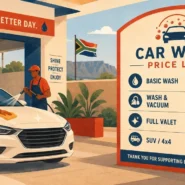


There is no single reliable national price for starting a car-wash franchise in South Africa. The amount can change substantially depending on whether the offer covers a mobile service, equipment only, a fitted wash bay or a complete site.
A proper budget may need to include property deposits, building work, drainage, water treatment, signage, professional fees, equipment, opening stock, VAT and working capital. Treat the cost bands below as planning scenarios, not as current advertised franchise prices or a promise that a business can be opened for that amount.
Start with the amount you can invest without using the cash needed for household expenses or the first months of trading. Then obtain current written quotations for the specific brand, site and operating model.
Under R50 000: mobile and waterless
You drive to the customer. Instead of a hose, you spray on a wash product and buff it off with a cloth. Your money goes into product, cloths, uniforms, and getting your name known.
No rent. No water bill. Nothing to build. You can start on weekends and keep your day job while you find out if you enjoy the work.
The catch: you are the business. Until you can afford to put someone else on the road too, you only earn when you’re out there working. You’re selling convenience, not size.
This suits you if you’ve got a reliable car and don’t mind knocking on doors at offices and complexes.
R200 000 to R500 000: your own bay
Here you’re renting a spot and washing by hand. Customers come to you, so you get through far more cars.
But you also pick up far more bills — rent, water, electricity, drainage, signage, wages. They land every month whether it’s busy or not.
At this level, the spot matters more than the brand. A good bay in a busy shopping centre makes money. The same setup two streets away can fail. Before you fall for a franchise’s pitch, find out what spots you can actually get.
R500 000 and up: machines
This is an automatic wash, or a bigger centre that adds detailing, small repairs, or tyres on top.
Machines take over from people, but only pay for themselves when enough cars come through. Put an automatic wash on a quiet street and you’ve just spent a lot of money to wash the same handful of cars you’d have managed by hand anyway.
The bigger centres bring in more per customer too. They also bring more staff, more things that can go wrong, and a longer wait before you’re making money.
What’s really in the price
When a franchisor gives you a number, it’s several things bundled together. Pull them apart, and ask what’s included and what you’ll still have to pay for:
- Joining fee — a once-off payment for the name. It doesn’t cover equipment or stock.
- Setting up the site — paving, drainage, bays, signage, pressure washers, vacuums. If the site is already paved, this drops a lot, which is why the same franchise quotes different people different totals.
- Royalty — a cut of everything you take in, not of your profit. You pay it even in slow months.
- Marketing fee — another cut, on top of the royalty.
- Soap and cloths — most franchises make you buy these from them. It’s a monthly bill, and it grows the more cars you wash.
- A cash buffer — money to keep the business running while it finds its feet. Three months’ worth is the least you should have on hand, and it sits on top of everything above.
How to get the real number out of them
No car wash franchise in South Africa puts its prices online. You’ll find a contact form and not much else. That’s normal — and once you’re in the conversation, you have more power than you think.
South Africa’s Consumer Protection Regulations require a franchisor to give a prospective franchisee a dated, signed disclosure document at least 14 days before the franchise agreement is signed. Ask for it by name before paying or signing.
The disclosure document must include specified information about the franchisor, its outlets, recent financial position, fees and initial investment requirements. Use the waiting period to test the numbers, speak to existing franchisees, inspect sites and obtain independent legal and financial advice.
That list is the most useful thing you’ll get. Here’s how to use your 14 days:
- Chat to a few of them yourself — not just the ones head office points you to. Ask what they take home in a month, what soap and cloths cost them, and how long before they stopped losing money.
- Sit outside two branches, an hour on a weekday and an hour on a Saturday. Count the cars. Check it against what you’ve been promised.
- Get your own quotes for paving, drainage, and equipment. Don’t just take their word for what it costs.
- Get an attorney to look over the contract. Unfair terms aren’t legal, so not everything written in there can actually be enforced.
You get 10 business days to cancel
Section 7(2) of the Consumer Protection Act 68 of 2008 allows a franchisee to cancel a franchise agreement in writing, without cost or penalty, within 10 business days after signing.
The franchise regulations require the text of that cancellation right to appear at the top of the first page of the agreement. Keep a dated copy of the signed agreement and proof of any cancellation notice. If a franchisor disputes the right or claims a deduction, ask for the legal basis in writing and obtain independent advice before accepting it.
Make sure it’s actually a franchise
Some of the cheaper deals are sold as a “business opportunity” instead of a franchise. That wording matters, because the disclosure document and the 10-day cancellation right only come with a real franchise agreement.
So ask them straight out: is this a franchise agreement under the Consumer Protection Act? How quickly, and how clearly, they answer tells you a lot.
Three things that decide if you make money
Water and drainage. Requirements for water use, trade effluent, stormwater, zoning and site works differ by municipality and property. Before signing a lease or buying equipment, ask the relevant municipality for the current written requirements for that site. The South African Government’s provincial and local government directory can help you find the correct municipality.
Staff. If you hire employees, check your registration and reporting duties using the Department of Employment and Labour’s UIF employer guidance and Compensation Fund employer guidance. Include wages, employer contributions, protective equipment and training in the monthly budget.
“`
Cars per day. This business runs on numbers, not on margin. Work out how many cars you’d need to wash daily just to cover rent, wages, royalties, and soap. Then go stand at the site and see if that many cars even drive past.
Compare another premises-based startup
If you are still comparing businesses that need a physical trading site, read our guide to spaza-shop container prices in South Africa. The operating model is different, but the comparison will help you test how much of your budget may be absorbed by premises, setup, utilities, permits and working capital.