




Most spaza shops make between R2,500 and R5,000 a month in profit.
That’s the finding from research into township spaza shops in the Mankweng area, based on a survey of 50 owners. It’s a long way from the numbers people imagine when they see a busy shop with customers queuing at the hatch.
The gap between what a shop turns over and what the owner actually keeps is where most of the confusion sits. Understanding that gap is the difference between a shop that lasts and one that closes inside two years, which is what happens to a large share of them.
Turnover is not profit
Accenture’s research into South Africa’s informal sector found that 58% of traders turn over between R5,000 and R20,000 a month.
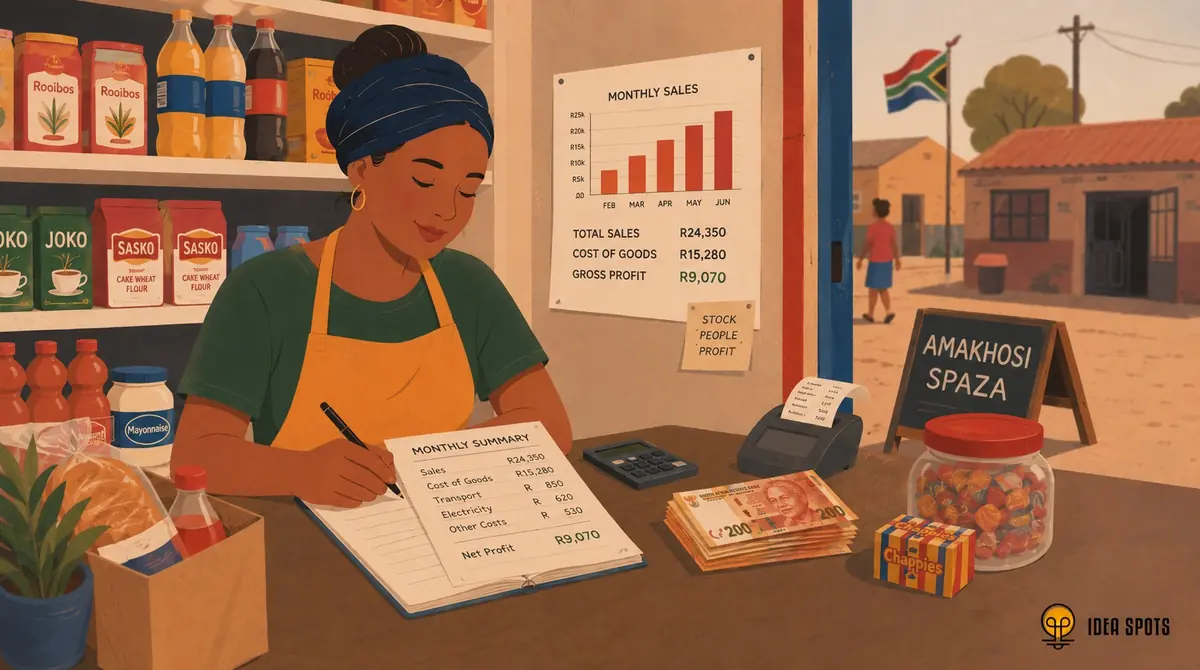
Turnover is the money that comes through the hatch. Profit is what’s left after you’ve replaced the stock you sold and paid everything else. On thin retail margins, a shop turning over R15,000 a month might keep R2,500 of it.
So when someone tells you their shop “makes R20,000 a month”, ask which number they mean. Usually it’s turnover.
Why margins are thin
A spaza buys at wholesale and sells at retail, and the gap between the two is smaller than most people expect, especially on the items that move fastest.
Your best sellers are usually your worst earners. Bread, mealie meal, milk, cooking oil and sugar are the reason people walk to your shop, but customers know what these cost, so you can’t mark them up much. Airtime and electricity work the same way. They bring people in, but you earn a small commission rather than a real margin.
The money is made elsewhere. Cold drinks, snacks, sweets, cigarettes and paraffin carry better margins, and prepared food carries the best of all. Shops that add a small kota or fried chicken window often earn more from that window than from the shelves behind it.
Small shops also buy in smaller quantities, which means paying more per unit than a larger shop buying bulk. That squeezes the margin further at exactly the size where it hurts most.
A worked month
Three shops, same neighbourhood, different scale.
The room or garage shop Turnover R8,000. Cost of stock sold R6,600. Gross profit R1,400. Electricity R250, waste and pest control R200, transport to the wholesaler R300. Monthly profit around R650.
This is the shop most people start with. It’s not a living. It’s a supplement, and it works best when the space costs nothing because it’s part of your home.
The container shop, established Turnover R22,000. Cost of stock sold R17,500. Gross profit R4,500. Electricity R600, waste and pest control R300, transport R500, licence and compliance spread over the year R150. Monthly profit around R2,950.
This sits squarely in the range the research describes, and it’s a realistic target for a well run first shop with proper refrigeration and consistent stock.
The busy shop with a food window Turnover R55,000, of which R15,000 is prepared food. Cost of stock sold R38,000. Gross profit R17,000. Electricity R1,200, gas R800, one assistant R4,000, waste and pest control R400, transport R900, compliance R200. Monthly profit around R9,500.
Getting here takes years, a strong location, and usually a second pair of hands. The food window is doing a lot of the work.
The costs people forget
- Transport to the wholesaler, which is a real weekly cost if you don’t own a vehicle
- Electricity, which climbs fast once you’re running two fridges and a freezer
- Stock that expires or spoils, particularly bread and dairy
- Theft and shrinkage, including from staff
- Load shedding losses, which is why an inverter pays for itself
- Waste removal and pest control, which you need anyway for your Certificate of Acceptability
- Licence renewal each year
None of these are large on their own. Together they’re often the difference between a shop that clears R3,000 and one that clears nothing.
What actually separates a small shop from a big one
Location. Foot traffic decides your ceiling before anything else does. A shop on a busy corner near a taxi rank will outsell a better-run shop on a quiet street every time.
Hours. Opening at 6am and closing at 8pm captures customers when the bigger stores are shut. Convenience is what people are paying for.
Refrigeration. Cold drinks are a high-margin line that also brings people in daily. A shop without reliable cold storage is leaving its best category on the table.
Range discipline. Roughly a fifth of your lines will produce most of your sales. Knowing which fifth, and never running out of them, matters more than carrying more products.
Credit control. Selling on tick is normal in townships, and it’s also the most common way a spaza dies. Money on the shelf is money you can sell. Money in someone’s promise is not. If you offer credit, keep a written book, set a limit per customer, and enforce it.
How long to break even
If you’re starting a container shop for around R85,000 to R105,000 and clearing R3,000 a month, you’re looking at roughly two and a half to three years to recover the setup cost.
That drops sharply if you get funding. The Spaza Shop Support Fund covers shop upgrades, equipment and stock, and part of it is a grant rather than a loan. Our guide to the Spaza Shop Support Fund covers what you can get and what you need to qualify.
It also drops if you start small from home and put every rand back into stock for the first year, rather than buying a container upfront.
What to stock first
Start narrow and go deep on the lines that move every day:
- Bread
- Maize meal
- Milk and maas
- Cooking oil
- Sugar, tea and coffee
- Eggs
- Cold drinks
- Airtime, data and prepaid electricity
- Snacks and sweets
- Paraffin and candles
- Soap, washing powder and basic toiletries
Add slower lines only once the fast ones never run out. Every rand tied up in a product that sits on the shelf for a month is a rand you can’t use to restock bread.
Is it worth it?
For a supplementary income from a room at home, yes. The startup cost is low, and the risk is contained.
As a full-time living, it’s harder than it looks. The research is blunt about sustainability, with most shops closing in the first few years. The ones that survive tend to have a good location, tight credit control, reliable refrigeration and an owner who works the counter personally.
Treat it as a business from day one. Keep records, separate the shop’s money from your own, and know your top ten sellers by heart.
Common questions
How much do I need to start? From about R15,000 trading out of a room at home, once you have the licence and stock. A container shop runs R45,000 to R105,000 depending on size, which our guide to spaza shop container prices breaks down.
How much can a spaza shop make a day? A small shop might take R200 to R400 a day in turnover. A busy one takes R1,500 or more. Profit is a fraction of that.
Do I need a business plan? For your own use, a simple one helps you work out whether the numbers hold. If you’re applying for funding, you’ll need proper documents rather than a plan, including a municipal permit, business registration and bank confirmation.
Is it better to sell food as well? Prepared food carries the best margins in the business, but it also brings extra health requirements and longer hours. Add it once the shop itself is stable.
Why do so many spaza shops close? Uncontrolled credit, poor location, running out of the fast-selling lines, and taking money out of the shop before it’s covered its costs. Most of these are fixable.
Can I run one part time? Not easily. The trading hours that make a spaza work are exactly the ones that clash with a job. If you can’t be there, you need someone you trust at the counter, and that cost changes the numbers considerably.