




Starting a spaza shop is not complicated, but it is sequenced. Do the steps in the wrong order and you’ll spend money you can’t recover, or wait months for approval you could have had in weeks.
The order that works is zoning, then health, then licence, then premises, then stock. Money comes last, not first.
Here’s the whole process.
Step 1: Decide how you’ll trade
Three models, three very different costs.
From a room or garage at home. The cheapest way in. You need the same licence and health certificate as anyone else, but no structure to buy. Around R15,000 gets you trading once the paperwork is done. Most successful shops start here.
From a container on your property or a rented stand. More visible, more secure, and it separates the business from your house. Costs R45,000 to R105,000 all in depending on size.
From rented premises. Rare for a first shop, because rent eats a thin margin fast, and you’ll need the landlord’s written permission before you can even apply for a licence.
Pick the model before anything else, because it changes the zoning question and the licence application.
Step 2: Check your zoning
Most residential properties aren’t zoned for trading. That doesn’t stop you, but it means you need a zoning certificate confirming trading is allowed, or consent use approval from the municipality.
Go to the municipal planning office and ask what your erf is zoned for and what a small shop requires. Some municipalities allow a small house shop as of right below a certain floor area, and require consent above it.
Do this first. It’s free or cheap to ask, it takes minutes, and a refusal here makes everything after it pointless.
Step 3: Get your Certificate of Acceptability
If you sell food, and nearly every spaza does, you need a Certificate of Acceptability from your municipality’s Environmental Health department. An Environmental Health Practitioner inspects the premises and issues it if you pass.
You’ll need clean enclosed food storage separate from your living space, shelving off the floor, working refrigeration with a thermometer, clean running water and a hand washing point, plus a waste removal arrangement and a pest control contract with invoices to prove both.
The certificate has to come before the licence, because the licence application asks you to attach it.
Step 4: Apply for your business licence
Once the health certificate is in hand, you can apply for the trading licence at the municipal business licensing office. You’ll need a recently certified ID copy, proof of address, the zoning certificate, business registration, proof of tax compliance, an affidavit from the property owner, and the Certificate of Acceptability itself.
Fees vary by municipality. Ekurhuleni charges R825 for twelve months, and most metros sit in the R500 to R1,500 range. Processing can take up to thirty working days.
The full document list, the order to submit in, and what each municipality asks for is covered in our guide to the spaza shop permit application form.
Step 5: Set up the premises
With approval secured, you can commit money to the structure.
If you’re going the container route, a converted 3m unit runs R11,000 to R16,000, a 6m unit R23,000 to R30,000, and a 12m unit R38,000 to R50,000. Delivery is separate, usually R2,000 to R8,000. Then there’s the base it stands on, the electrical connection and compliance certificate, refrigeration, shelving, a counter and security.
The container itself is only a quarter to a third of what you’ll spend. Our breakdown of spaza shop container prices prices every line and gives three worked setup budgets.
Whatever the model, an inverter and battery is worth budgeting for. A freezer that thaws twice a week costs more in spoiled stock than the backup would have.
Step 6: Know your numbers before you open
This is the step most people skip, and it’s why so many shops close inside two years.
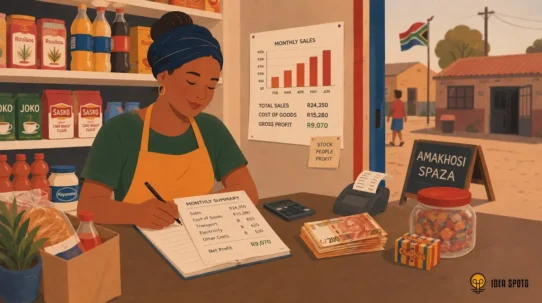
Research into township spaza shops found most make between R2,500 and R5,000 a month in profit, on turnover that typically runs R5,000 to R20,000. Margins on your fastest sellers, bread, mealie meal, milk and airtime, are thin by design, because customers know what those cost.
Work out what your shop needs to turn over to cover its costs and pay you something, before you commit. Our breakdown of how much a spaza shop makes a month works through three shops at different scales, with the costs that come off the top.
Step 7: Apply for funding
With a valid licence, you can apply to the Spaza Shop Support Fund. It offers up to R100,000, with funding above R50,000 split half grant and half loan, and it covers shop upgrades, equipment and stock purchases.
The fund is underspent rather than oversubscribed. Around R320 million of the R500 million allocation was still unspent by mid 2026, and the main reason applications fail is a missing or invalid municipal permit.
Eligibility, documents and the application process are covered in our guide to the Spaza Shop Support Fund.
Writing your business plan
You don’t legally need a business plan to open a spaza shop. You do need one if you’re borrowing money, and you’ll make better decisions if you write one either way.
Keep it to a few pages and cover:
- What you’ll sell. Your core range, and which lines you expect to move daily.
- Where you’ll trade. The location, the foot traffic, and who else already serves that street.
- Who your customers are. Household size, income pattern, and when they shop.
- Startup costs. Structure, fit-out, licence, opening stock, itemised.
- Running costs. Electricity, transport to the wholesaler, waste and pest control, any wages.
- Expected turnover. Daily takings multiplied out, with a realistic and a pessimistic version.
- Where stock comes from. Your wholesaler, how often you’ll buy, and how you’ll get there.
- Compliance. Licence, health certificate, and renewal dates.
- Risks. Credit, theft, load shedding, a competitor opening nearby, and what you’d do about each.
Write the pessimistic version honestly. If the shop only works on your best case numbers, it doesn’t work.
How long the whole thing takes
- Zoning enquiry: same day
- Zoning certificate or consent use: two weeks to three months
- Certificate of Acceptability: two to four weeks
- Business licence: up to thirty working days
- Container order and delivery: about a week
- Fund application: several months
Realistically, three to four months from first enquiry to open door, longer if you need consent use.
The mistakes that cost the most
Buying the structure first. People order a container before they know whether they can trade from the site. Zoning approval can be refused.
Selling on credit without a book. Selling on tick is normal and it’s also the most common way a spaza dies. Written record, limit per customer, enforced.
Carrying too many lines. A fifth of your products will produce most of your sales. Going deep on those beats going wide.
Taking money out too early. The shop has to cover its own restocking before it pays you. Separate the shop’s money from your own from day one.
Skipping the health certificate. Selling food without a valid Certificate of Acceptability carries a fine or imprisonment of six to twenty-four months.
Common questions
Do I need to register a company? Not necessarily. You can trade as a sole proprietor. CIPC registration costs R175 and becomes a requirement if you receive more than R80,000 from the Spaza Shop Support Fund, and some municipalities ask for it as part of the licence application.
Can I start while I have a job? It’s hard. The trading hours that make a spaza work, early morning and evening, are the ones that clash with employment. If you can’t be at the counter, you need someone you trust there, and that wage changes the numbers.
Do I need a licence if I trade from my own house? Yes. The licence attaches to the trading activity, not the building. Trading from home also means the property owner affidavit applies to you, even if that owner is you.
Can foreign nationals open a spaza shop? You can apply for a municipal trading licence with valid Home Affairs documentation permitting business activity. The Spaza Shop Support Fund is restricted to South African citizens, or people naturalised before 1994.
What sells best? Bread, maize meal, milk, cooking oil, sugar, eggs, cold drinks, airtime and prepaid electricity, snacks, paraffin and basic toiletries. The staples bring people in daily. The margin comes from cold drinks, snacks and prepared food.
Is it too late to start, with so many shops already? Location decides this more than saturation does. A street that’s a long walk from the nearest shop is an opportunity regardless of how many spazas exist in the township overall.