




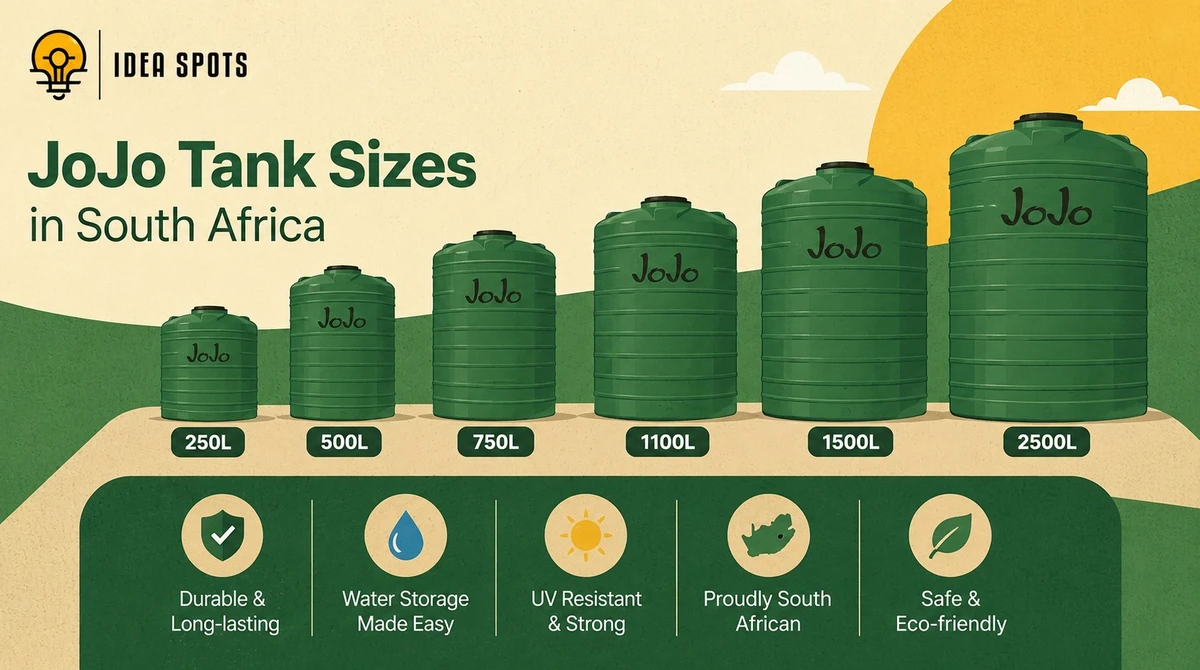

Picking a tank looks simple until the delivery arrives. The 5 250 litre tank is 1.82 metres across. Most side passages aren’t. The 10 000 litre tank stands 3.15 metres tall, which is higher than the gutter it’s supposed to fill from.
Capacity is the easy half of this decision. The harder half is whether the tank fits where you want it, whether it comes with the fittings your setup needs, and how many days of water it really buys you.
The vertical range
These are the familiar upright tanks. They need a level, solid base and they stay put once they’re full.
| Size | Diameter | Height |
|---|---|---|
| 260 L | 670 mm | 940 mm |
| 500 L | 840 mm | 1 080 mm |
| 1 000 L | 1 110 mm | 1 300 mm |
| 1 500 L | 1 410 mm | 1 200 mm |
| 1 800 L | 1 200 mm | 1 780 mm |
| 2 000 L | 1 420 mm | 1 450 mm |
| 2 400 L | 1 420 mm | 1 700 mm |
| 2 700 L | 1 420 mm | 1 860 mm |
| 4 750 L | 1 820 mm | 2 060 mm |
| 5 250 L | 1 820 mm | 2 255 mm |
| 5 500 L | 1 900 mm | 2 240 mm |
| 10 000 L | 2 200 mm | 3 150 mm |
| 15 000 L | 2 600 mm | 3 260 mm |
| 20 000 L | 2 600 mm | 4 270 mm |
You can download the spec sheet for any individual size from the JoJo vertical tank range.
Watch the 1 500 and the 1 800. The 1 500 is wider but 580 mm shorter, so under a low roof overhang the bigger tank is the one that fits.
The 2 000, 2 400 and 2 700 all measure 1 420 mm across. They take up identical floor space and differ only in height. If you have the headroom, there’s no reason to choose the 2 000.
Sizes built for tight spaces
If your only spot is a passage between two houses or a narrow strip along a boundary wall, the round tanks are out, and the slim range is in.
| Size | Narrowest side | Length | Height |
|---|---|---|---|
| 750 L Slimline | 760 mm | round | 1 850 mm |
| 1 000 L Slimline | 840 mm | round | 2 060 mm |
| 1 000 L SuperSlim | 400 mm | 2 020 mm | 1 800 mm |
| 1 500 L MultiSlim | 760 mm | 1 620 mm | 1 890 mm |
| 2 500 L MultiSlim | 760 mm | 2 500 mm | 1 960 mm |
The SuperSlim is the one to know about. At 400 mm, it’s narrower than most interior doorways, and it holds the same 1 000 litres as a round tank that needs 1 110 mm of space. It’s a long, flat tank that sits flush against a wall.
The trade-off is cost and waiting. The SuperSlim and both MultiSlim tanks are made to order rather than kept in stock, and the slim shapes cost more than a round tank holding the same water.
When height is the problem
Sometimes the issue isn’t width, it’s that a tall tank looks wrong or blocks a window.
The low profile tanks are wide and squat. The 5 000 L is 2 230 mm across but only 1 560 mm high. The 10 000 L is 2 420 mm across and 2 550 mm high, a full 600 mm shorter than the vertical tank holding the same water.
Horizontal tanks sit lower still. The 4 500 L is 1 430 mm high, and there’s a 5 500 L at 1 505 mm. There’s a 2 500 L that comes in around 1 210 mm, though the moulds differ slightly in the Western and Eastern Cape, so check the measurements with your local branch rather than assuming.
If you don’t want a tank visible at all, there’s a 6 000 litre underground tank. It’s built to hold its shape under soil pressure when it’s empty, which is exactly where a tank not designed for burial gives way. It needs retaining walls, and it’s a proper excavation job rather than a weekend project.
What each size costs
Tank prices move around a lot. The same tank can differ by two thousand rand between a hardware chain, an agricultural co-op and a plumbing supplier, and colour affects it too. The premium shades add about 10%.
These are the prices you’ll typically see on the shelf:
| Size | Typical price |
|---|---|
| 260 L | around R1 550 |
| 1 000 L Slimline | R2 000 to R2 200 |
| 2 400 L | R2 400 to R2 900 |
| 2 700 L | R3 900 to R5 200 |
| 4 750 L | around R5 400 |
| 5 250 L | R5 500 to R7 600 |
| 10 000 L | R15 000 to R17 500 |
The 2 400 is the value pick, and it isn’t close. Work out what you’re paying per litre and the gap is stark: the 260 L costs you close to R6 a litre of storage, while the 2 400 comes in near R1. Every size below 2 400 is expensive water. If the space and the headroom allow it, going bigger is cheaper.
The jump from 5 250 to 10 000 runs the other way. You’re not paying double for double the water; you’re paying closer to triple. The 15 000 and 20 000 litre tanks get quoted per job rather than shelf-priced, because they carry transport costs and need a 50% deposit up front.
Two costs people leave out. A concrete plinth or a steel stand, which you need whatever size you buy. And a pump, if you want normal pressure at the taps.
Phone around before you buy. JoJo’s distributor finder lists the branches near you, and the spread between two of them is often worth the calls.
How long each size actually lasts
This is where people get the sizing wrong, in both directions.
Plan on about 150 litres per person per day for normal life. That covers showers, laundry, dishes, flushing and the garden.
But nobody uses 150 litres a day during an outage. You ration. Drinking, cooking, a quick wash and careful flushing comes closer to 50 litres a person, and at that rate a tank lasts three times longer.
For a household of four:
| Tank size | Normal use | Rationing |
|---|---|---|
| 500 L | under a day | about 2½ days |
| 1 000 L | about 1½ days | about 5 days |
| 1 500 L | about 2½ days | about 7 days |
| 2 400 L | 4 days | about 12 days |
| 2 700 L | about 4½ days | about 13 days |
| 5 250 L | about 8½ days | about 26 days |
| 10 000 L | about 16 days | about 50 days |
If you want the taps to behave normally through a two-day municipal shutdown, size for normal use. If you want to get through a long outage without panic, size for rationing. A 2 400 gets you further than you’d think.
Measure before you buy, not after
Do this with a tape measure. It takes ten minutes, and it’s the step people skip.
- Find the narrowest point on the route from the street to the spot, whether that’s the pedestrian gate, the passage, or a corner it has to turn. Write that number down.
- Compare it to the tank’s diameter or narrowest side. The tank arrives empty, so weight isn’t the problem. Width is.
- Measure the height clearance where it will stand. Gutters, eaves, washing lines, overhanging branches. You also need room above the lid to open it.
- Add 100 mm to the tank’s diameter. That’s the size of the concrete base, so check the footprint still fits.
- Check what’s above the inlet, and where overflow water will run. Straight into a foundation or a neighbour’s wall is a problem you only discover in the first big storm.
The base matters more than it sounds. Water weighs a kilogram a litre, so a full 2 400 L tank puts about 2.4 tonnes on one spot. It needs level paving, a proper tank stand, or a concrete plinth at least 85 mm thick and 100 mm wider than the tank’s diameter. Nothing should hang over the edge of the base.
Four popular sizes have no overflow fitting
This one catches people out.
The 260 L, 2 000 L, 2 400 L and 4 750 L ship without an overflow fitting. Every other size in the range has one.
For municipal backup, that’s usually fine, because a float valve shuts the fill off. But if you’re harvesting rain, the tank fills and then keeps receiving water with nowhere for it to go. It runs out from under the lid and down the side onto whatever is below.
The 2 400 is one of the most popular tanks in the country and a common rainwater choice. If that’s your plan, either take the 2 700 instead, which has the same diameter and does have an overflow, or budget to have one fitted.
The warranty isn’t the same on every size
The tanks carry a ten-year warranty, except the two smallest. The 260 L and 500 L come with three years.
That’s worth knowing if you’re buying small for a flat or a garden. You’re not getting the same cover as the bigger tanks, and two small tanks are not the same deal as one medium one. Shop listings get this wrong fairly often, so go by the spec sheet rather than the product page.
The warranty also depends on installing it properly:
- No steel, iron or metal fittings on the tank
- Flexible pipe between the tank and any fixed plumbing, so nothing puts the tank under strain
- A level, smooth base with no overhang
- Nothing standing on the lid, which isn’t built to carry weight
Which sizes you can get this week
Most of the range sits in stock: 260, 500, 1 000, 1 500, 1 800, 2 000, 2 400, 2 700, 4 750, 5 250 and 10 000 litres, plus the 750 and 1 000 L Slimline.
Made to order, so expect a wait: the SuperSlim, both MultiSlim tanks, and the 15 000 and 20 000 litre tanks.
The 5 500 L is a special order, so check with the branch before you plan around it.
A tank on the ground gives you almost no pressure
Gravity gives you roughly 0.1 bar for every metre of height. Municipal supply arrives at somewhere around 2 to 4 bar.
So a tank standing on a plinth gives you a trickle. Good enough for a garden tap or filling buckets. Nothing like a shower.
Raising it helps less than people expect. Even three metres up, you’re at about 0.3 bar. The steel stands made for the 5 000 and 10 000 litre tanks go up to 1.5, 3, 4.5, 6 and 9 metres, and there’s an adjustable stand for the Slimline tanks that runs from 50 mm to 2.5 m.
If you want your taps to work normally off the tank, you need a booster pump, and that’s a real line in the budget rather than an accessory. Plan for it when you plan the tank, not afterwards.
If you’re harvesting rain, your roof sets the ceiling
A big tank doesn’t help if your roof can’t fill it.
The sum is easy: one millimetre of rain on one square metre of roof gives you one litre. So 20 mm of rain on a 100 m² roof is about 2 000 litres, and you’ll catch a bit less once you allow for splash, first-flush diversion and what the gutters miss.
Check your area’s typical monthly rainfall against your roof area. In a summer-rainfall region, a 5 250 will fill and overflow repeatedly through the wet months. Through a dry stretch that same tank sits half empty, and a 2 400 would have done.
The usual mistake isn’t buying too small. It’s buying big storage fed by a small roof.
So which one
For a flat or a small garden, 500 to 1 000 litres covers watering and a short outage.
For a family of four wanting real municipal backup, 2 400 or 2 700 is the sweet spot. Same footprint, and the 2 700 has the overflow.
For rainwater harvesting on a decent roof, 5 250 upward, as long as the roof can keep up.
For a smallholding, livestock or irrigation, 10 000 and up, with transport and the deposit priced in.
And if the spot you have is narrower than 1.1 metres, the slim range is your answer, not a smaller round tank.
Common questions
What size tank does a family of four need?
For normal use through a short outage, 2 400 litres gives you about four days. Ration carefully and the same tank stretches to nearly two weeks. That’s why the 2 400 and 2 700 are the most common household choices.
What’s the difference between the 2 400 and the 2 700?
Same 1 420 mm diameter, so the same floor space. The 2 700 is 160 mm taller, holds 300 litres more, and comes with an overflow fitting the 2 400 doesn’t have.
Which tank works in a narrow space?
The 1 000 L SuperSlim at 400 mm, or the 750 L and 1 000 L Slimline at 760 mm and 840 mm. Anything from 1 500 litres up in the round range needs at least 1.4 metres of width.
Do I need a pump?
If you want shower and geyser pressure, yes. Gravity from a stand gives you a fraction of a bar, where your municipal line gives 2 to 4. Without a pump, you have a working garden tap and a way to fill buckets.
Can I bury a standard tank?
Not as it comes. A tank not designed for burial can lose its shape under soil pressure once it’s empty. The purpose-built underground tank is the one made for the job, and even standard tanks put below ground need retaining walls built around them.
How long do the tanks last?
The warranty runs ten years on everything from 1 000 litres up, and three years on the 260 and 500. The tanks are made to the national standard for water tanks, SANS 1731, and the warranty holds as long as the base and fittings are right.
Can I put a tank on a balcony or a wooden deck?
Not without checking the structure first. Even a 500 litre tank is half a tonne when full, concentrated on a small footprint. Have someone look at the load before you fill it.
Does colour change the price?
Slightly. Standard colours are the cheapest, and the premium shades add around 10%. The tank itself is identical.