

The biggest mistake people make when starting a recycling business in South Africa is collecting first and looking for buyers later.
That is backwards.
Recycling is not one business. It can mean collecting plastic bottles from households, buying cans from waste pickers, running a buy-back centre, collecting cardboard from shops, selling scrap metal, baling PET for recyclers, or operating a full recycling facility.
Each version needs different buyers, equipment, space, transport and paperwork.
If you are starting small, begin with a collection business. Find out what your nearest buyer pays for, collect only those materials, sort them properly, and build volume before you spend money on a scale, trolley, bakkie, yard or baler.
Choose the recycling business model first
There are four practical entry points.
| Business model | What you do | Best for beginners? |
|---|---|---|
| Collection route | Collect recyclables from homes, shops, schools or events and sell to a buy-back centre | Yes |
| Small buy-back point | Buy sorted material from collectors and resell to larger centres or recyclers | Maybe, once you understand prices |
| Scrap metal collection | Collect or buy legal scrap metal and sell to registered scrap dealers | Good money, but more compliance risk |
| Processing or recycling facility | Sort, bale, crush, granulate, wash or process material for recyclers or manufacturers | Not for most beginners |
Start with the simplest question: who will buy the material from you?
If you cannot answer that, you do not have a recycling business yet. You have a pile of waste.
Pick one or two materials to start with
Do not collect everything. It sounds efficient, but it usually creates dirty mixed loads that buyers do not want.
For a beginner, the easiest materials are:
- PET plastic bottles
- aluminium cans
- cardboard
- white office paper
- mixed paper
- HDPE bottles
- clean scrap metal from legal sources
The best material depends on your nearest buyer.
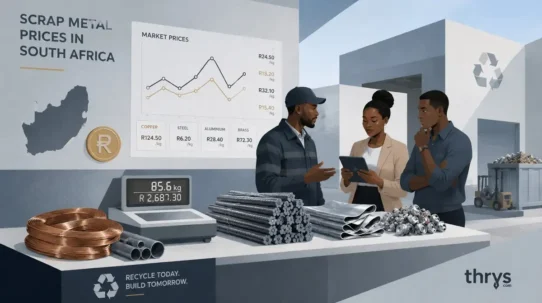
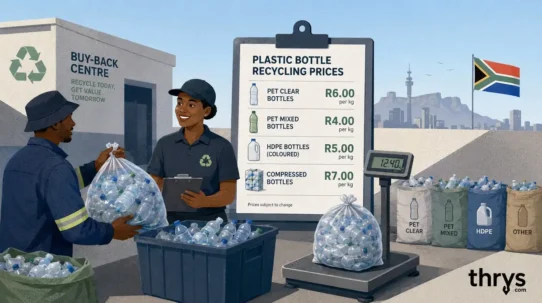
PET bottles and cardboard are common, but they pay low per kg. Aluminium cans pay more per kg, but you need many cans to make weight. Scrap metal can pay much more, but copper, brass and other metals come with legal and sourcing risks.
Use these cluster guides before choosing:
Find buyers before you collect
Your first job is to find the nearest place that pays for the material.
Possible buyers include:
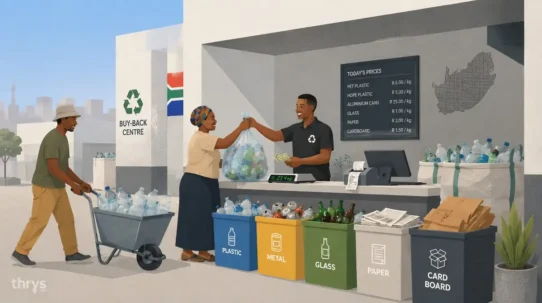
- recycling buy-back centres
- scrap yards
- intermediate collectors
- PET bottle recyclers
- cardboard and paper buyers
- community recycling projects
- waste-management companies
- larger collectors with balers
PETCO explains that many recyclers buy material only when it is baled, meaning pressed into large dense bundles. If you do not have a baler, you may need to sell to an intermediate collector or buy-back centre first.
That is normal. Beginners usually start lower in the chain and move up when they have volume.
To find buyers, start with the recycling buy-back centres guide, PETCO’s buy-back centre directory, your municipality’s recycling pages, and local scrap yards.
Phone the buyer and ask the right questions
Before you collect anything, phone the buyer.
Ask:
- What materials are you buying today?
- What is the price per kg?
- Do you buy small loads or only bulk?
- Do you require material to be baled?
- Do you pay different prices for clear PET, coloured PET and HDPE?
- Do you buy aluminium cans and steel cans separately?
- Do you buy cardboard if it is not perfectly dry?
- What time do you accept deliveries?
- How do you pay?
- Do I need ID or business documents?
Write the answers down. Prices change, but the buyer’s rules tell you how to collect.
Work out the numbers before spending money
Recycling is a weight business. You are paid by kilograms, but you spend money on time, bags, sorting, storage and transport.
Use a simple calculation:
Income = weight collected x price per kg
Profit = income - transport - bags - helper costs - storage costs
Example:
| Material | Weight | Price per kg | Income |
|---|---|---|---|
| PET bottles | 50 kg | R3/kg | R150 |
| Aluminium cans | 20 kg | R18/kg | R360 |
| Cardboard | 80 kg | R0.80/kg | R64 |
| Total | 150 kg | mixed | R574 |
If transport costs R250, your working profit before your own time is R324.
That is why route planning matters. The money is not only in finding material. It is in collecting enough material without driving all over town.
Start with a simple collection route
A good beginner route has regular sources close together.
Look for:
- households in one street
- spaza shops
- taverns
- restaurants
- schools
- churches
- offices
- car washes
- salons
- event venues
- small shopping areas
Offer a simple arrangement: they keep bottles, cans or cardboard separate, and you collect weekly or monthly.
Give them labelled bags if you can. If they mix food waste into the bag, your price drops. Your job is partly collection and partly training people to sort properly.
Equipment you need to start small
You do not need a full recycling yard to begin.
Basic setup:
- bulk bags or strong woven bags
- gloves
- closed shoes or boots
- a trolley, cart or wheelbarrow
- a basic scale if you can afford one
- permanent marker and labels
- separate bags for each material
- phone with WhatsApp for buyer and customer communication
Useful later:
- platform scale
- sorting table
- storage cage
- trailer
- bakkie
- protective clothing
- branded bags or bins
- simple invoice or receipt book
- baler, only when volume justifies it
Do not buy a bakkie before you have a route. Do not buy a baler before you have material volume and a buyer who pays more for baled material.
Sorting rules that protect your price
Sorting is where small recycling businesses win or lose money.
Keep separate:
- clear PET bottles
- coloured PET bottles
- HDPE bottles
- aluminium cans
- steel cans
- cardboard
- office paper
- mixed paper
- glass
- scrap metal
Keep material clean and dry where possible. Wet cardboard loses value. Food-contaminated plastic may be rejected. Mixed cans can be downgraded. Scrap metal with attachments may be paid at a lower grade.
If your buyer says they want clear PET only, do not arrive with mixed plastic and hope for the best.
When to register the business
You can start informally as a collector, but formal registration becomes useful when you want to:
- open a business bank account
- invoice businesses
- apply for support programmes
- employ people
- rent a yard
- supply larger buyers
- register on supplier databases
- apply for equipment support
- build a proper buy-back centre
South Africa’s BizPortal, run by CIPC, allows company registration online. It also links to tax registration, UIF, Compensation Fund, B-BBEE certificates for qualifying exempt micro enterprises, and business bank accounts.
Do not register only because it sounds official. Register when it helps you get buyers, support, contracts, banking or credibility.
Licences and compliance to check
The requirements depend on what you actually do.
For a simple collection route, you may not need a waste-management licence, but you still need permission to collect from properties and you must follow municipal rules about dumping, storage and transport.
If you operate a yard, store large volumes, process waste, bale, crush, wash, granulate, treat, recover or dispose of waste, you may need municipal approval or a waste-management licence depending on the activity and scale.
If you deal in scrap metal, the Second-Hand Goods Act becomes important. SAPS has forms and processes for registering second-hand goods dealers and recyclers. Scrap metal is sensitive because of stolen copper, cable theft and infrastructure damage.
Check these before expanding:
- CIPC company registration
- SARS tax registration
- municipal zoning or business rules
- waste storage and handling requirements
- waste-management licence requirements if processing or operating a facility
- SAPS second-hand goods registration if dealing in scrap metal
- health and safety requirements if employing people
- UIF and Compensation Fund registration if you have employees
If you are unsure, ask your municipality or local environmental-health/waste-management office before signing a lease or buying equipment.
Registering in the waste-sector ecosystem
In June 2026, the Department of Forestry, Fisheries and the Environment called on compliant SMMEs in the waste sector with valid CIPC numbers to register on the Waste Economy Enterprises Repository of South Africa, known as WEERSA.
The point of WEERSA is to map waste-sector businesses, connect role players and give MSMEs information about funding and empowerment opportunities.
This does not replace your business registration or any licences you may need. Think of it as a visibility and support database for waste-sector enterprises.
Can waste pickers register?
South Africa also has the South African Waste Picker Registration System. PETCO has noted efforts to help integrate waste pickers and support registration on that system.
If you are an individual waste picker, collector or small recycling operator, registration may help you become visible to programmes, service-fee systems or support structures. Availability and benefits can change, so check with PETCO, your municipality, local waste-picker organisations or relevant support programmes.
How to move from collector to buy-back centre
Do not open a buy-back centre too early.
Move up only when you have:
- regular collectors bringing material
- a confirmed buyer for each material
- enough space to sort safely
- a reliable scale
- clear price lists
- a way to pay collectors
- records of what you buy and sell
- transport to move bulk loads
- permission to operate from the site
- enough working capital to pay collectors before you resell
The danger with a buy-back centre is cash flow. You may pay collectors today but only sell the material later. If prices drop or the buyer rejects a load, your money gets stuck.
Start as a collector. Become an intermediate collector. Then consider a buy-back point.
How to make the business more profitable
Profit improves when you:
- collect from nearby points
- collect on fixed days
- sort better than competitors
- focus on materials your buyer actually wants
- keep transport costs low
- build relationships with schools and small businesses
- weigh material before selling
- compare buyers regularly
- avoid contaminated loads
- negotiate better prices once you have volume
The upgrade path is usually:
- Collect small loads.
- Build regular sources.
- Sort properly.
- Add a scale.
- Add more collection points.
- Add transport.
- Sell larger volumes.
- Add storage.
- Add baling only when it improves the price enough.
Do not skip straight to step nine.
Common mistakes
Avoid these:
- collecting without a buyer
- buying equipment before you have volume
- collecting too many material types
- mixing clean recyclables with dirty waste
- ignoring transport costs
- taking wet cardboard
- accepting suspicious scrap metal
- promising businesses free collection before knowing your route cost
- opening a yard without checking zoning and municipal rules
- relying on one buyer only
- not keeping weight and payout records
The small operators who survive are usually the organised ones.
Simple startup checklist
Use this order:
- Choose your area.
- List possible collection points.
- Find two or three buyers.
- Ask each buyer what they buy and what they pay.
- Pick one or two materials.
- Set up bags or drums.
- Collect from a small route.
- Sell the first load.
- Record weight, income and transport cost.
- Improve the route before spending on equipment.
- Register the business when you need formal buyers, banking or support.
- Check licences before renting space or processing material.
Frequently asked questions
How do I start a recycling business in South Africa?
Start by choosing one or two materials, finding buyers first, setting up a small collection route, sorting properly and tracking weight, payout and transport costs. Register formally once you need business banking, contracts, employees or support programmes.
What recycling business is best for beginners?
A small collection route is usually best. PET bottles, aluminium cans and cardboard are easier to start with than a full buy-back centre or processing facility.
Do I need to register a recycling business?
Not always at the very beginning if you are collecting informally, but registration becomes useful when you want business banking, contracts, support programmes, employees, premises or larger buyers.
Do I need a licence to collect recycling?
A simple collection route may not need a waste-management licence, but municipal rules still matter. A yard, storage site, processing activity or recycling facility may need municipal approval or a waste-management licence depending on the activity and scale.
Do I need SAPS registration for scrap metal?
If you run a business dealing in scrap metal or recycling controlled metals, the Second-Hand Goods Act and SAPS registration requirements may apply. Check the SAPS second-hand goods resources before buying or selling scrap metal as a business.
How much money can a recycling business make?
It depends on weight, material prices, sorting quality, buyer prices and transport cost. A small household route may make modest money, while a larger collection route with regular business sources can become more serious.
What equipment do I need?
Start with bags, gloves, labels and basic transport. Add a scale, trolley, storage, trailer, bakkie or baler only when the route and volume justify the cost.
Should I start with plastic bottles or scrap metal?
Plastic bottles are easier and lower-risk, but they pay less per kg. Scrap metal can pay more, but it needs legal sourcing and more compliance awareness.