




The shelf price of a JoJo tank is not what the tank costs you. It’s roughly half.
By the time you’ve paid for a base, the fittings, delivery and a pump, a R3 000 tank has become a R7 000 or R8 000 job. Nobody tells you that at the till, and it’s the reason so many tanks sit in back gardens connected to nothing.
Here’s what the tank costs, and what the rest costs.
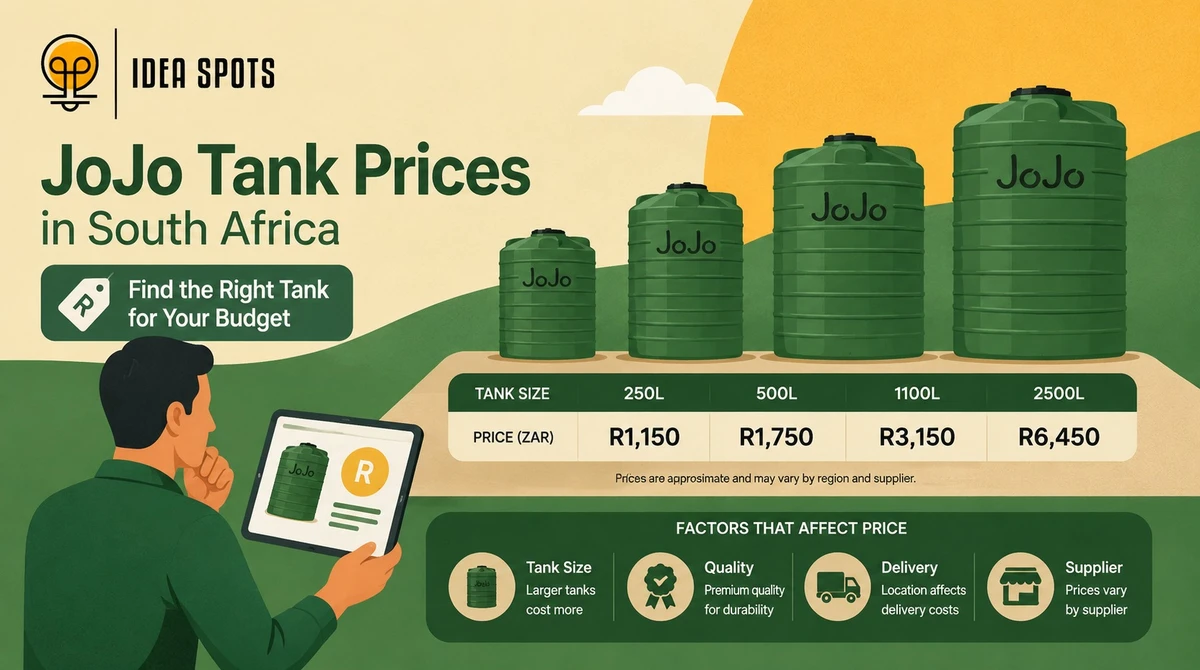
What each size sells for
| Size | Typical price |
|---|---|
| 260 L | around R1 550 |
| 1 000 L vertical | around R2 460 |
| 1 000 L Slimline | R2 000 to R2 200 |
| 2 400 L | R2 900 to R3 300 |
| 2 700 L | R4 700 to R5 150 |
| 4 750 L | around R6 200 |
| 5 250 L | R5 500 to R7 000 |
| 10 000 L | around R17 500 |
Price is only half the choice, because the tank also has to physically fit where you want it. The full size list with diameters and heights covers that side of it.
The 15 000 and 20 000 litre tanks don’t carry a shelf price. They’re quoted per job, they attract transport costs, and they need a 50% deposit before the order is confirmed.
The same tank costs different money at different branches
This catches people out more than any other thing about tank pricing.
At Cashbuild, the price you see depends on which store you’re shopping. Pick a different branch and the number changes. There is no single national Cashbuild price for a 2 400 litre tank.
So a price you read online, including the ones above, is a guide and not a quote. The tank at your nearest branch may be a few hundred rand either side.
The gap between chains is bigger still, and it doesn’t run in one direction. On a 2 400, Cashbuild came in around R400 dearer than Leroy Merlin. On a 5 250, the gap widened to about R1 500. But on a 2 700, Cashbuild was roughly R450 cheaper.
No retailer is cheapest across the range. Which means phoning two or three for the specific size you want is worth real money, not just a few rand. JoJo’s own distributor finder will give you the branches near you to call.
Bigger is cheaper, and it isn’t close
Work out the price per litre of storage, and the small tanks look terrible.
A 260-litre tank at around R1 550 costs you close to R6 for every litre it holds. A 2 400 at R3 000 costs about R1.25. You’re paying nearly five times as much per litre for the small one.
That gap keeps closing as you go up, until it reverses. The 2 400 sits at roughly R1.25 a litre. The 2 700 is nearer R1.80. The 5 250 comes in around R1.20 to R1.30. Then the 10 000 jumps to about R1.75.
So the value band is the 2 400 and the 5 250. The 2 700 is expensive for what it adds, and the 10 000 costs roughly two and a half times the 5 250 for double the water.
If your space and your headroom allow it, buying up is cheaper water. If you’re choosing between two sizes and the price difference feels small, take the bigger one.
What the shelf price leaves out
This is the part that turns a R3 000 tank into a R7 000 project.
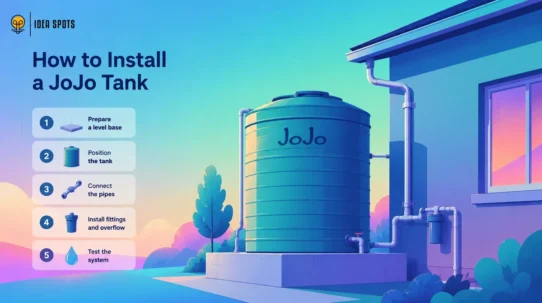
A base. The tank cannot stand on soil or on uneven paving. You need level paving already in place, a concrete plinth, or a steel stand. A plinth means cement, stone, sand and either your weekend or a labourer’s day rate. A stand costs more but goes in immediately.
Fittings and pipe. The tank comes with an inlet and an outlet, but the gutter connection, the flexible pipe, a tap, and a float valve if you’re filling from municipal supply are all separate. Budget a few hundred rand.
Delivery. A 2 400 is 1.42 metres across and a 5 250 is 1.82 metres. That’s a bakkie or a delivery fee, not a car boot. On the biggest tanks, transport is quoted separately because it’s a genuine logistics problem.
A pump, if you want pressure. This is the big one. Gravity gives you about 0.1 bar for every metre of height, while your municipal line arrives at 2 to 4 bar. A tank on a plinth gives you a trickle. Good for a garden tap and filling buckets, nothing like a shower. If you want the taps and the geyser to behave normally, you need a booster pump, and that is a substantial line of its own rather than an accessory.
Installation, if you’re not doing it yourself. Connecting a tank into house plumbing properly is plumber’s work. Rerouting a downpipe is not.
Add those up and the honest rule is to double the tank price for a basic rainwater setup, and more than double it if you want pressurised municipal backup.
Where you can actually buy each size
Range differs by retailer, and it’s narrower than the catalogue suggests.
Cashbuild stocks five JoJo tank lines: the 1 000, 2 400, 2 700, 4 750 and 5 250. No 500, no 1 500, no 1 800, no 2 000, no 10 000, and nothing from the Slimline range.
So if you’ve decided on a 1 800 or a Slimline, checking who carries it comes before comparing price. The chains carry the popular middle of the range and little else. Agricultural co-ops and plumbing suppliers tend to carry more of the odd sizes and the bigger tanks.
The full range, including the sizes the chains skip, is listed on JoJo’s own site.
Colour changes the price slightly
Standard colours are the cheapest. The premium shades carry about a 10% uplift, which on a 5 250 is a few hundred rand.
The tank itself is identical. You’re paying for the pigment, not for a better tank.
Where the money is best spent
If your budget is tight, the order that gets you the most useful water is this.
- Buy the biggest tank your space allows, since price per litre falls as you go up. Measure the gate and the side passage before you commit, because width decides this more often than budget does.
- Pay for a proper base. A tank on a bad base is a warranty claim waiting to happen, and the warranty depends on getting this right.
- Connect it to something, even if that’s only a downpipe and a tap. A disconnected tank stores nothing.
- Add the pump later, once the rest works. It’s the most expensive piece and the easiest to defer.
The common mistake is spending the whole budget on capacity and having nothing left for the base and the connection, which leaves a large empty tank in the garden.
Common questions
How much is a JoJo tank?
Between roughly R1 550 for the smallest 260 litre tank and around R17 500 for a 10 000. The most popular household size, the 2 400, runs about R2 900 to R3 300 depending where you buy.
Which size gives the best value?
The 2 400 and the 5 250. Both work out near R1.25 a litre of storage, where the 260 costs close to R6 a litre and the 2 700 and the 10 000 both sit above R1.75.
Why do prices differ so much between shops?
Partly normal retail competition, and partly because some chains price per store rather than nationally. Cashbuild is one of those, so two branches can quote you different numbers for the same tank.
What else do I need to budget for?
A base, fittings and pipe, delivery, and a pump if you want proper pressure. Doubling the tank price is a fair working estimate for a complete setup.
Do I really need a pump?
For a shower or a geyser, yes. Gravity from a stand gives you a fraction of a bar against the 2 to 4 bar your municipal line delivers. Without a pump, you have a garden tap and a way to fill buckets.
Are the bigger tanks worth it?
Up to the 5 250, yes, because the price per litre keeps improving. Above that, it stops improving, and the 15 000 and 20 000 add transport costs and a deposit on top.
Does the price include installation?
No. The shelf price is the tank alone. Some retailers and distributors can arrange installation separately, and JoJo lists approved installers on its site.