




A converted spaza shop container will be quoted to you somewhere between R11,000 and R45,000 depending on size. That number is real, and it’s also the smallest part of what you’ll spend getting the shop open.
Here’s what each size costs, and what sits behind the quote.
Container prices by size
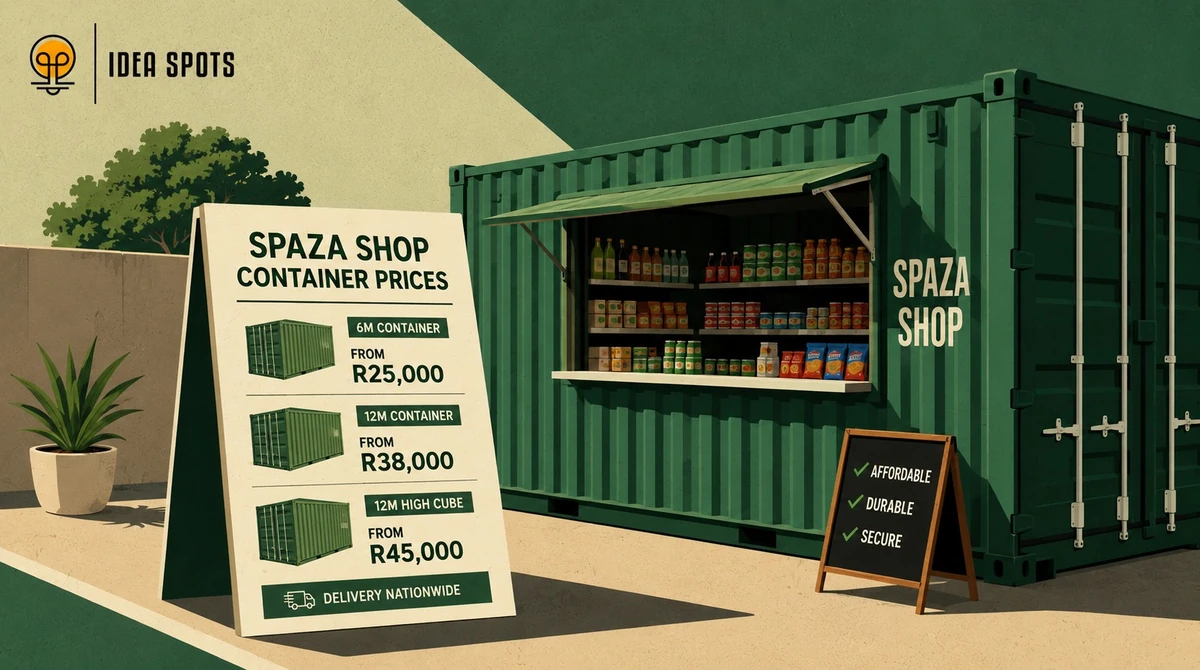
Suppliers in South Africa work in three sizes: 3m (10ft), 6m (20ft) and 12m (40ft). BBD Containers publishes a full converted price list, which gives a useful reference point:
| Unit | Size | Price |
|---|---|---|
| Office / kiosk container | 3m | R14,000 |
| Office container | 3m | R15,000 |
| Kiosk container | 6m | R23,000 |
| Spaza container | 6m | R25,000 |
| Container shop with shelves | 6m | R26,000 |
| Mobile office container | 6m | R29,000 |
| Home container | 12m | R38,000 |
| Offices container | 12m | R45,000 |
At the cheaper end, BOSS Containers lists a 10ft by 8ft spaza shop container at R11,000. Other suppliers, including Container King, Absolute Containers and FS Containers, quote on request rather than publishing prices.
As a working range: R11,000 to R16,000 for a 3m, R23,000 to R30,000 for a 6m, and R38,000 to R50,000 for a 12m.
What “converted” actually includes
This is where quotes stop being comparable. A typical 6m spaza conversion includes a steel combi door with lock and key, a serving hatch, bulkhead lights, a DB board, double plug points, a light switch, and paint inside and out.
That’s a shell with power points in it. It is not a fitted shop.
Ask every supplier to confirm in writing whether the quote covers:
- Shelving and a counter
- Flooring, since bare steel or plywood wears fast
- A security grille or shutter over the serving hatch
- Burglar bars on any windows
- Ventilation, which matters more than people expect in a steel box in summer
- Signage or branding
- Roof insulation
Suppliers like Absolute Containers list shelving, counters, refrigeration facilities, aircon and electrical wiring as options rather than standard. Two quotes that look R4,000 apart can be R15,000 apart once you match the specification.
New or used, and why the grade matters
Most converted spaza units are built from used containers. That’s normal and fine, but grade varies a lot.
A used 6m container runs R20,000 to R35,000 unconverted, and a new one-trip container runs R50,000 to R75,000 for a 6m and R90,000 upward for a 12m. Set that against a converted 6m spaza unit at R25,000 and the arithmetic tells you something: at that price, the base container is a lower-grade used unit, not a one-trip container.
That isn’t a reason to walk away. It’s a reason to inspect. Before you pay, check the floor for soft spots and rot, the roof for standing water and rust, the door seals, and the corner castings. Ask whether the unit is wind and water-tight, and get the answer in writing.
If you want a one-trip container as the base, expect the finished conversion to land closer to R70,000 for a 6m.
Delivery is the cost people forget
Delivery is quoted separately almost everywhere. Expect R2,000 to R8,000, and more than R10,000 if you’re rural or your site is hard to reach.
What drives the number:
- Distance from the supplier’s nearest depot
- Whether a tilt bed truck can reach your site, or whether a crane truck is needed
- Access, meaning road width, overhead cables, gates and turning space
- Container size, since a 12m needs a bigger truck
Lead time is usually about a week. Walk the route to your site before you order, not after the truck arrives and can’t turn in.
Always ask for a delivered price rather than a container price. A supplier 40km away quoting R27,000 delivered often beats one quoting R24,000 from 300km out.
Site preparation
A container needs to sit level on something solid. Put it straight onto soft ground, and the doors stop closing within a season.
- Compacted gravel base: R1,500 to R4,000
- Concrete plinths or footings at the corners: R2,000 to R6,000
- Full concrete slab: R8,000 to R20,000 depending on size
Plinths are the common choice for a spaza. A full slab is worth it if you’re staying put for years or if the municipality treats the structure as permanent, which affects zoning.
Getting power
Most conversions come with a DB board and plug points, but nothing connects them to anything. You’ll need a registered electrician to link the unit to a supply and issue an Electrical Certificate of Compliance.
The certificate is the predictable part. Inspection and issue start at around R850 excluding VAT for the first hour, with roughly R600 an hour after that, and most jobs land between R850 and R2,500. Gauteng averages about R1,100. If the electrician finds faults, repairs are quoted separately and commonly add R1,000 to R6,000.
The connection work is the variable part, since it depends on how far you sit from a supply point and whether the municipality will allow a new connection at all.
- Electrical Certificate of Compliance: R850 to R2,500
- Wiring and connection to supply: R2,500 to R8,000
- Prepaid meter installation, where the municipality allows it: R1,500 to R4,000
- Small inverter and battery for load shedding: R6,000 to R15,000
The inverter isn’t optional if you sell cold drinks and frozen goods. A fridge that thaws twice a week costs more in spoiled stock than the backup would have.
Fitting out the shop
This is where the second half of your budget goes.
Refrigeration is the line worth getting right, and retail prices are easy to check. At Makro, a Fridgestar 95L chest freezer runs R2,599, a Hisense 198L is R3,499, a Defy 195L is R3,999, a Hisense 297L is R4,499 and a Defy 481L is R6,999. An 85L under-counter beverage cooler is R4,999, and a 150L single door upright fridge is R3,998.
Glass door commercial display coolers from brands like Staycold and Fridgestar cost a lot more, and a large upright commercial freezer can pass R25,000. Suppliers such as Cool Solutions and Eezicool quote on request. For a first shop, domestic chest freezers plus one display cooler is the sensible route.
- Chest freezer, 95L to 200L: R2,600 to R4,000
- Chest freezer, 300L to 480L: R4,500 to R7,000
- Under-counter beverage cooler: around R5,000
- Single door upright fridge: R4,000 to R6,000
- Card machine: from around R500 upfront, then a percentage per transaction
Shelving, counters, security shutters and signage are quoted per job rather than sold off a shelf, so treat these as planning figures and get three quotes:
- Shelving: R3,000 to R12,000
- Counter and till point: R1,500 to R5,000
- Security gate or roller shutter: R4,000 to R12,000
- Signage: R1,500 to R6,000
Suppliers like iKhokha and Yoco sell entry-level card machines aimed at small traders. Taking card is worth setting up early, since it cuts the amount of cash on the premises and gives you a sales record you’ll need if you ever apply for funding.
Opening stock
Budget R8,000 to R25,000 for a first stock run at a wholesaler, depending on the size of the shop and how much you carry in fridges.
Buy narrow and deep to start. Bread, milk, maize meal, cold drinks, airtime, sugar, oil, eggs, snacks and paraffin move constantly. Slow lines tie up money you need for restocking.
Compliance costs
You can’t legally trade from the container without a business licence and, if you sell food, a Certificate of Acceptability. Budget R1,000 to R3,000 for the licence fee, zoning certificate, ID certification and affidavits, and more if you need consent-use approval. Our guide to the spaza shop permit application form covers the documents and the order to get them in.
Do this before the container arrives. Zoning approval can be refused, and a container standing on a site you’re not allowed to trade from is an expensive ornament.
What it really costs to open
Three realistic budgets, container included.
Small 3m shop, secondhand kit, R45,000 to R55,000 Container R11,000 to R15,000, delivery R2,500, gravel base R2,000, electrical CoC and connection R4,000, chest freezer R3,000, shelving R4,000, security R5,000, stock R10,000, compliance R2,000.
Standard 6m shop, R85,000 to R105,000 Container R25,000, delivery R4,000, plinths R4,000, electrical CoC and connection R7,000, inverter R9,000, freezer and beverage cooler R12,000, shelving and counter R10,000, security shutter R8,000, signage R3,000, stock R15,000, compliance R2,500.
12m shop with fuller range, R150,000 to R190,000 Container R45,000, delivery R7,000, slab R14,000, electrical R9,000, inverter R14,000, refrigeration R25,000, fit-out R20,000, security R12,000, signage R5,000, stock R25,000, compliance R3,000.
The pattern holds across all three. The container is roughly a quarter to a third of the total.
Renting instead of buying
Most suppliers rent 3m and 6m units, and what you pay depends heavily on whether you want a plain container or a fitted one.
For plain storage units, Henmar Hire lists R770 plus VAT a month for a 3m, R880 plus VAT for a 6m and R1,760 plus VAT for a 12m, on rates valid to February 2027. Orange Plant Hire quotes R1,000 including VAT a month for a 6m in Queenstown, with in-town delivery at R650.
Fitted units cost roughly three times that. Henmar lists a 6m office container at R2,600 plus VAT a month, or R2,700 with aircon, and a 3m at R2,200 plus VAT. A converted spaza unit sits in that bracket, not the storage one.
Twelve-metre units often aren’t rented at all, because of the yard space and the truck size involved.
Renting makes sense if you’re testing a location or your site is temporary. If you’ll be there more than about two years, buying is cheaper, and a container holds its value well enough that you can resell or relocate it.
Where the funding fits
The Spaza Shop Support Fund offers up to R300,000 per shop through a mix of grants and low-interest loans, and it specifically covers infrastructure improvements, refrigeration, shopfitting and point of sale systems. That maps almost exactly onto the costs above.
The catch is that you need a valid original municipal trading licence or business licence to apply, issued by the municipality rather than a councillor, and photocopies aren’t accepted. Sort the paperwork first, and the fund can carry a large share of the setup.
Applications go through SEDFA and the National Empowerment Fund, with details on the official fund site.
Common questions
What’s the cheapest way to start? A 3m unit on a gravel base with used refrigeration, around R45,000 all in. You can also start trading from a room or garage at home while you save, provided you have the licence and Certificate of Acceptability for those premises.
Is a 3m container big enough? For a first shop serving a small area, yes. You’re serving through a hatch rather than letting customers walk in, so floor space matters less than shelf space and fridge capacity. The constraint you’ll hit first is refrigeration.
Do I need building plans? Usually not for a container treated as a temporary or semi-permanent structure, but it depends on your municipality and your zoning. Some treat a container on a permanent slab as a building. Ask the planning department before you pour concrete.
Can I move it later? Yes, and that’s the main advantage over building. Relocation costs about the same as the original delivery. If the site isn’t working, you’re not stuck with it.
How long does a container shop last? A well-maintained converted container lasts twenty years or more. Rust at the base is what kills them, which is why the plinths or slab matter as much as the paint.
Should I buy the conversion or convert it myself? Buying a converted unit is usually cheaper than buying a plain container and paying separately for cutting, welding, doors, and wiring. Converting yourself makes sense only if you already have the trade skills or a fixed relationship with a fabricator.