




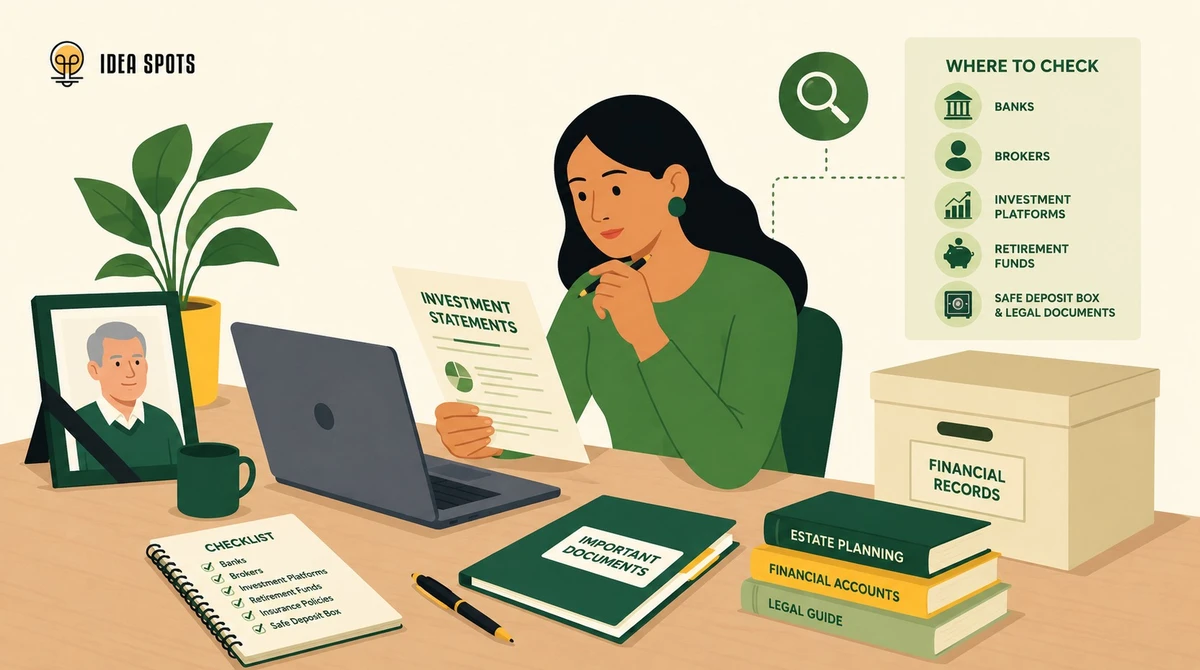

When someone dies, their paperwork rarely arrives in a neat folder marked “everything you need”. Families often find one old statement, a tax certificate, a debit order reference, or a faded policy schedule and then wonder whether there are still investments somewhere.
This is common. Many investments are now handled by email, online platforms, advisers, and administrators. If nobody knew where the documents were kept, a unit trust, life policy, shareholding, retirement benefit, or investment account can easily be missed when the estate is reported.
The safest approach is to work from official documents, use the right authority, and contact the correct provider. This checklist will help you trace possible investments without handing personal documents to the wrong person.
If you need an overview of every possible search route first, begin with our complete unclaimed-money checklist for South Africa.
When the paperwork identifies the product, use the matching guide: follow our steps for tracing old unit trusts and investment accounts or finding a lost life-insurance policy.
Start with the estate authority
Before a provider can discuss a deceased person’s account, it will normally need proof that you are allowed to act for the estate.
The Master of the High Court supervises the administration of deceased estates in South Africa. The Department of Justice explains that, when a person dies, the estate is frozen and no one may deal with estate assets without the necessary permission from the Master.
For larger estates, the Master issues letters of executorship. For smaller estates, the Master may issue letters of authority. According to the Department of Justice, if the value of the estate exceeds R250,000, letters of executorship must be issued, and the full deceased-estate process applies. If the value is less than R250,000, the Master may issue letters of authority under section 18(3) of the Administration of Estates Act.
If you are not the executor or authorised representative, start by speaking to the person who is. Most investment companies, insurers, banks, retirement funds, and transfer secretaries will not release account details to a relative simply because they are a child, spouse, sibling, or beneficiary.
Build a simple asset-search file
Create one folder, physical or digital, for the search. Keep every clue in one place.
Useful documents include:
- The death certificate;
- The death notice or estate reporting documents;
- The letter of executorship or letter of authority;
- The will, if there is one;
- The deceased person’s ID document;
- Marriage certificate or divorce order, if relevant;
- Old bank statements;
- Tax certificates;
- Unit trust or investment statements;
- Policy schedules;
- Share certificates or dividend vouchers;
- Retirement fund benefit statements;
- Emails from advisers, brokers, banks, insurers, or platforms; and
- Any FSP number, account number, policy number, portfolio number, or client number.
Do not wait until you have every document. Start with what you have, then add clues as they appear.
Search bank statements first
Bank statements often reveal investments that the family never knew about. Look at both incoming and outgoing transactions.
Search for:
- Monthly debit orders to investment companies;
- Contributions to unit trusts, tax-free investments, endowments, or retirement annuities;
- Adviser fees;
- Income distributions, dividends, or interest payments;
- Payments from an asset manager, bank, insurer, or investment platform;
- References such as “portfolio”, “unit trust”, “investment”, “income fund”, “RA”, “annuity”, or “policy”; and
- Annual or semi-annual payments that may not appear every month.
If you only have recent bank statements, ask the bank what older records are available. Even one old debit order reference can point you to the correct provider.
Check old tax records
Investment providers often issue tax certificates. These may show interest, dividends, capital gains, retirement annuity contributions, or investment income.
Look for:
- IT3(b), IT3(c), or other investment tax certificates;
- Retirement annuity contribution certificates;
- Dividend tax certificates;
- Capital gains tax records;
- SARS correspondence mentioning investments or estate assets; and
- Emails from tax practitioners or accountants.
SARS explains that, when a person dies, that person’s assets at date of death are placed in a deceased estate, and the executor administers the estate until the remaining assets are distributed to beneficiaries. Tax records are therefore useful not only for tracing assets, but also for helping the executor understand what must be reported.
Contact financial services companies directly
ASISA’s guidance is clear: if you believe you are entitled to an investment that has not been cashed in, you need to contact the financial services company involved. ASISA also notes that the company will require proof that the person making the enquiry has a valid interest in the investment account.
This means your best first contacts are the companies named on old documents:
- Asset managers;
- Linked investment service providers or investment platforms;
- Life insurers;
- Banks;
- Financial advisers or brokerages;
- Retirement fund administrators;
- Transfer secretaries for shares; and
- Companies that issued employee share schemes or BEE shares.
When you contact a provider, ask whether the deceased person had, or previously had, an account or policy with them. Give the deceased person’s full names, ID number, date of birth, date of death, and any account or policy number you have. Ask what documents they need from the executor or authorised representative.
Trace unit trusts and investment accounts
If the clue points to a unit trust, investment platform, tax-free investment, endowment, or old investment policy, start with the company named on the statement or tax certificate.
Ask:
- Is there an active or dormant investment account?
- Was the investment transferred to another platform or provider?
- Was it paid out before death?
- Were communications returned or contact details marked outdated?
- What documents are needed from the executor?
- Are there unpaid income distributions or balances?
ASISA represents many South African asset managers, collective investment scheme management companies, linked investment service providers, multi-managers, and life insurers. Its membership and collective investment scheme information can help identify a provider or fund name, but it is not a public search engine for every individual’s account.
Trace life policies and investment policies
Some investments sit inside insurance structures, especially endowments, living annuities, funeral policies, life cover, or older savings policies. The paperwork may look like an investment statement, but the provider may treat it as a policy.
Search for:
- Policy schedules;
- Premium debit orders;
- Annual benefit statements;
- Beneficiary nomination forms;
- Maturity notices;
- Correspondence from life insurers; and
- Adviser emails mentioning cover, maturity, surrender, or claim forms.
If a policy paid directly to a nominated beneficiary, it may not follow the same path as an ordinary estate asset. The insurer will confirm the claim process and whether the executor, beneficiary, or both must submit documents.
Check retirement funds separately
Retirement benefits are not the same as ordinary investments. Pension funds, provident funds, preservation funds, and retirement annuities have their own rules and administrators.
If the deceased person may have belonged to a retirement fund, use the FSCA’s unclaimed benefits search for retirement-fund benefits. The FSCA says its central database helps members of the public check whether unclaimed retirement benefits may be due.
Useful clues include:
- Old payslips;
- Employer names;
- Pension or provident fund statements;
- Retirement annuity certificates;
- Mining or industry fund records;
- Benefit statements; and
- Correspondence from fund administrators.
If you find a possible match, the fund or administrator will confirm what documents are needed. Do not assume the estate automatically receives the money; retirement funds have specific beneficiary and dependency processes.
Check shares and unpaid dividends
If the deceased person owned listed shares, BEE shares, employee shares, or old share certificates, check for unpaid dividends and share-register records.
The JSE’s Claim It service allows people to search for unclaimed dividends. For a deceased estate, the JSE lists documents such as a letter of executorship or letter from the Master, death certificate, estate banking proof, beneficiary and executor identification, proof of residence, and proof of ownership or a copy of the share certificate.
If you find an old share certificate, contact the official transfer secretary or the company’s investor-relations team. Ask whether the certificate is still active, whether there are unpaid dividends, and what is required to update or transfer the holding.
Check the Guardian’s Fund if minors were involved
If a minor child, legally incapacitated person, absent heir, or untraceable heir was entitled to money, the funds may have been paid into the Guardian’s Fund.
The Guardian’s Fund is administered by the Master of the High Court. The Department of Justice explains that it holds and administers money paid to the Master on behalf of minors, persons incapable of managing their own affairs, unborn heirs, missing or absent persons, and others with an interest in certain money.
The Department of Justice also publishes an unclaimed Guardian’s Fund list annually in September. This is worth checking if the family knows that an inheritance, policy benefit, or estate payment may have been held for a child or missing heir.
Be careful with digital accounts
Families often miss investments because the records are locked behind email accounts, phones, cloud storage, and online portals.
Look for:
- Email subject lines containing “statement”, “investment”, “tax certificate”, “portfolio”, “policy”, “beneficiary”, “maturity”, or “dividend”;
- PDF statements saved in Downloads or Documents folders;
- Password manager entries for banks, insurers, platforms, and brokers;
- SMS messages from financial institutions;
- Adviser contact details in phone contacts; and
- App notifications or installed investment apps.
Do not log into accounts unlawfully or impersonate the deceased. Use the information as clues for the executor or authorised representative to contact the provider properly.
Watch for recovery scams
Deaths create paperwork, urgency, and emotion. Scammers know this.
Be cautious if someone contacts the family first and claims to have found money in the deceased person’s name. Verify the company through official sources, check FSP details where relevant, and call the provider using contact details from its official website.
Red flags include:
- A demand for an upfront release fee;
- Requests for online banking passwords, card PINs, OTPs, or remote access;
- Pressure to keep the claim secret from the executor;
- Refusal to provide official company details;
- Email addresses that do not match the provider’s domain; and
- Bank details in a private person’s name.
Real claims may involve administration steps, certified documents, FICA checks, and estate banking details. They should not require you to hand over control of your bank account.
Practical tracing checklist
Use this order:
- Confirm who has authority to act for the estate.
- Gather the death certificate, will, estate papers, and authority documents.
- Search bank statements for investment payments and income.
- Search tax records for investment certificates and provider names.
- Contact companies named on old statements, emails, and debit orders.
- Check ASISA member and fund information for investment providers.
- Use the FSCA search for possible unclaimed retirement benefits.
- Use JSE Claim It for unpaid listed-company dividends.
- Check the Guardian’s Fund if minors or untraceable heirs were involved.
- Keep copies of every document, email, reference number, and call note.
Frequently asked questions
Can I ask an investment company if my deceased parent had an account?
You can ask, but the company will usually require proof that you have a valid interest or authority to act. The executor or person holding letters of authority is normally the right person to make formal enquiries.
What if there is no will?
The estate still needs to be reported to the Master of the High Court if the person died leaving property or a document that is or appears to be a will. If there is no valid will, the estate is dealt with under intestate succession rules, and the Master will still need to appoint or authorise the correct person to administer the estate.
Can old investments be found after the estate is already finalised?
It can happen. If a new asset is discovered after an estate has been finalised, speak to the executor, estate attorney, or the Master of the High Court about the correct process. Do not try to claim the asset privately.
Is the FSCA search for all investments?
No. The FSCA unclaimed benefits search is mainly for unclaimed retirement-fund benefits. Ordinary unit trusts, investment policies, platform accounts, and share dividends usually need to be traced through the relevant provider, administrator, transfer secretary, or JSE Claim It where applicable.
What if the only clue is an old adviser name?
Search for the adviser, brokerage, or FSP number through the FSCA. Then look for the product provider named on any statement, tax certificate, mandate, or bank payment reference. The provider may still hold the account even if the adviser has retired or the brokerage has closed