




An old share certificate can feel like a dead end, especially when the company has changed its name, merged, or stopped sending letters years ago. But a missing certificate is not the same thing as a missing shareholding.
The first job is to establish whether the shares still exist, who administers the register, and whether there are unpaid dividends attached to the holding. From there, the process is mostly about proving ownership, updating your records, and using the right official channel.
Start with the JSE Claim It search
If you think you, a parent, or another relative may be owed dividends from a JSE-listed company, start with the Johannesburg Stock Exchange’s Claim It service.
The JSE says you can check for unclaimed dividends using an ID number. If the search shows a possible match, you will need to verify and update your details, including proof of address and banking information, before payment can be processed.
Check for unclaimed dividends through JSE Claim It
This is a good first step, but do not treat a no-match as proof that no shareholding exists. A shareholding may be held through a broker or CSD Participant, administered by a different transfer secretary, or relate to an unlisted company.
Work out what kind of holding you are tracing
Before you send documents anywhere, try to identify which of these situations applies:
- You have an old paper share certificate. The certificate should show the company name, shareholder name, certificate number, and number of shares.
- You remember owning shares but have no paperwork. Search old bank records, dividend vouchers, tax records, emails, and family files for an issuer, broker, or adviser name.
- The shares belonged to someone who has died. The executor or authorised representative will normally need to handle the claim.
- The shares were bought through a broker or investment platform. The broker, nominee, or CSD Participant may be the correct starting point, not the company directly.
Do not rely on a company name alone. Companies can delist, merge, change names, or be acquired. The issuer’s investor-relations page or transfer secretary can help explain what happened to an older holding.
If you still have the share certificate
Keep it safe and make a clear copy for your records. The certificate is useful evidence, but it may not be enough on its own to claim a dividend or trade the shares.
Contact the company’s transfer secretary or investor-relations team using details published on the company’s official website. Ask them to confirm:
- Whether they administer the company’s share register;
- Whether the certificate is still recorded as active;
- Whether there are unpaid dividends or other entitlements; and
- What they need to update the holding or replace/dematerialise the certificate.
For shares administered by Computershare, its current guidance says a holder can ask for a replacement certificate or request that the shares be dematerialised into a CSD Participant account. It asks for information including the issuer name, the registered holder’s details, ID number, contact details, and the number of shares. The exact process and fees can differ by issuer.
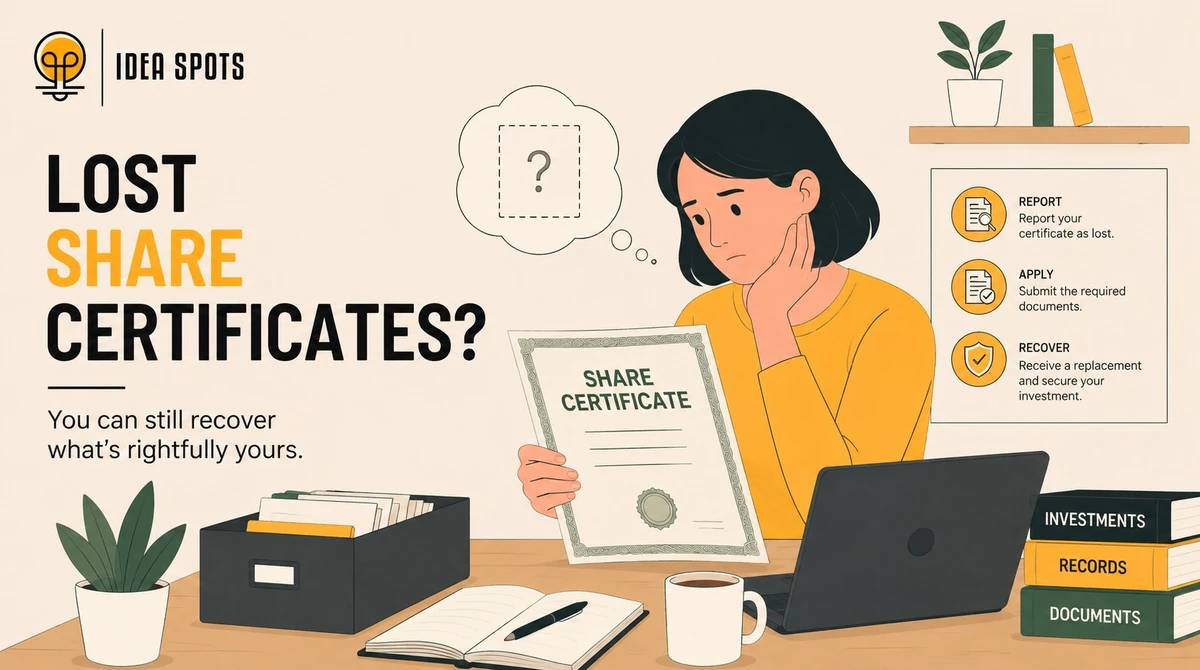
If the certificate has been lost
Do not rush to pay a “share-recovery agent” who contacts you out of the blue. Start with the official transfer secretary.
Computershare’s lost-certificate process, for example, begins with a notification form. It then verifies the holder’s details and asks for proof of ownership, which can include a dividend advice, a copy of the certificate, or another record of the shareholding. A replacement can involve an administration fee and an indemnity requirement, so ask for the current requirements and costs directly from the transfer secretary before making a payment.
The key point is that a lost certificate is a verification problem, not a reason to give up. Keep copies of every document you submit and record every reference number.
If you are tracing shares or dividends for a deceased relative
This process is more formal because the company or transfer secretary must deal with the correct estate representative.
The JSE says that, for a deceased estate claim, supporting documents may include:
- A letter of executorship, letter of authority, or another letter from the Master of the High Court;
- The death certificate;
- Proof of ownership or a copy of the share certificate;
- Identification and banking documents for the estate, executor, or beneficiary; and
- Proof of residence where required.
Do not assume that being a child, spouse, or beneficiary automatically authorises you to receive information or payment. If an estate is being administered, speak to the executor first.
Update the details that stop dividends from reaching you
Unclaimed dividends often arise because the register has old information. A shareholder may have moved, changed surnames, changed bank accounts, or died without the holding being picked up in the estate.
Once you find the right transfer secretary or CSD Participant, ask how to update:
- Your residential and postal address;
- Mobile number and email address;
- Banking details;
- Surname or other personal details; and
- Tax residency or dividend-tax declarations, where relevant.
Computershare says claimants must have up-to-date banking details and meet its FICA requirements before it can pay outstanding entitlements. Its listed requirements include identity, proof of address, and proof of banking details.
Understand the difference between a certificate and a tradable holding
You may be able to prove an old holding with a paper certificate, but that does not mean you can simply sell it straight away.
Computershare states that you cannot trade with a paper certificate; the holding must first be dematerialised and held in a FICA-verified CSD Participant account. Dematerialisation turns a paper-based holding into an electronic record held through an authorised participant or broker.
If your aim is only to claim unpaid dividends, the transfer secretary can tell you what is needed. If you also want to sell the shares, ask about dematerialisation, account-opening requirements, and dealing costs before you proceed.
Do not guess the value of the holding
An old certificate can represent a valuable holding, a small number of shares, a company that no longer trades, or shares that were converted during a corporate action. The value depends on what happened to the company and the holding over time.
Avoid paying anyone who promises a quick payout before verifying the claim. Work from official company, JSE, broker, or transfer-secretary contact details, and confirm any bank account details independently before sending money or documents.
Your practical tracing checklist
Before you start, collect:
- The certificate, if you have it, plus a clear copy;
- The shareholder’s full name, previous surname, and ID or passport number;
- The company name shown on the certificate;
- Any dividend vouchers, broker statements, bank records, or correspondence;
- Your own ID, proof of address, and bank confirmation letter or recent bank statement;
- Estate documents and death certificate, if you are acting after a death; and
- A record of calls, emails, names, and reference numbers.
Then follow this order:
- Search JSE Claim It with the relevant ID number.
- Identify the issuer, broker, CSD Participant, or transfer secretary connected to the holding.
- Use contact details from an official website, not a link sent by an unknown caller.
- Ask what proof of ownership and FICA documents are needed.
- Update verified banking and contact details.
- Ask about dematerialisation only if you want to hold or sell the shares electronically.
- Keep copies and reference numbers until the dividend or shareholding is resolved.
Frequently asked questions
Can I search for unclaimed dividends with only an ID number?
The JSE says its Claim It service allows people to check for unclaimed dividends using an ID number. A potential match still needs to be verified with supporting documents and updated details.
Can I sell shares using an old paper certificate?
Not directly. According to Computershare, the holding must be dematerialised and held in a FICA-verified CSD Participant account before it can be traded.
What happens if the shareholder has died?
The claim will generally need to be handled through the estate. The JSE lists estate authority, a death certificate, proof of ownership, and identity, banking, and residence documents among the requirements for a deceased-estate dividend claim.
Will I receive the full gross dividend amount?
Not necessarily. Dividend tax and the details of the particular holding can affect the amount paid. Ask the transfer secretary or a qualified tax adviser if you need advice about your specific position.